
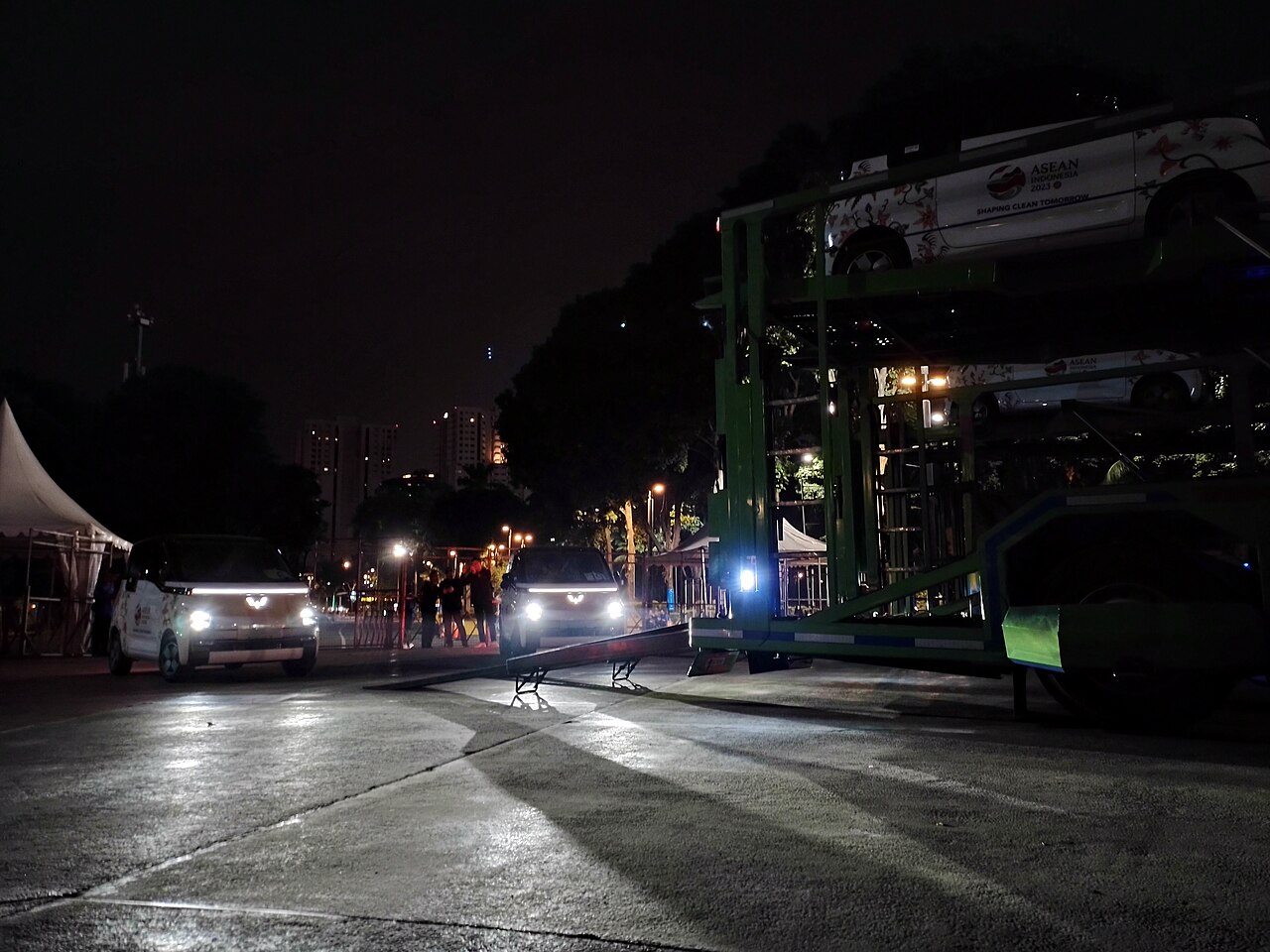
Top image: Wuling Air EVs being unloaded in Jakarta. Photo: RasyaAbhirama13, CC BY-SA 4.0, via Wikimedia Commons

Indonesia’s battery electric car market is on course for a record year, but one economist is cautioning that the growth may not be as solid as the headline numbers suggest. The Institute for Development of Economics and Finance (INDEF) expects factory-to-dealer shipments of battery EVs (BEVs) to reach between 160,000 and 175,000 units in 2026, Kontan reported.
Where the market stands
According to Gaikindo wholesale data cited by Kontan, BEV shipments totalled 134,571 units from January to October 2026. That is 17.7% of the 760,476 cars shipped nationally over the same period. In October alone, BEV wholesales were 16,791 units, up from 16,042 in September, as we reported in our October EV sales round-up.
M. Rizal Taufikurahman, who heads INDEF’s Centre for Macroeconomics and Finance, said the year-end forecast assumes vehicle supply holds up and that year-end promotions help drive purchases.
Our calculation: to reach INDEF’s range, the industry would need to ship roughly 25,400 to 40,400 more BEVs in November and December, or about 12,700 to 20,200 a month. For comparison, the January–October average works out at about 13,460 a month. If the last two months simply matched October’s 16,791, the full-year figure would be about 168,000, close to the middle of INDEF’s range.
Shipments are not the same as sales
Rizal’s main caveat concerns what wholesale figures actually measure. Gaikindo’s wholesales count cars sent from factories and importers to dealers, not cars bought by drivers.
“Distribution to dealers must be followed by sales to consumers so that growth does not merely reflect a build-up of stock,” Rizal told Kontan (translated from Indonesian).
He credited the rise of BEVs to increasingly competitive prices, a wider choice of models and relatively low running costs, which have led more buyers to see electric cars as an economical option. However, he said buyers still weigh financing costs, resale values and the availability of after-sales service before committing.
Switching, not new demand
Rizal also argued that a larger BEV share does not by itself prove that household purchasing power is recovering across the board. Part of the growth, he said, is likely to come from buyers who would otherwise have bought a petrol car, rather than from additional demand in the car market as a whole.
On incentives, he took a middle position. In his view, the market’s growth cannot be described as depending purely on subsidies, but it has not yet proven that it can stand on its own without government support. The real test, he said, is whether sales hold up once incentives are reduced. He added that incentives should be aimed at building domestic production, local components and jobs, not just at stimulating consumption.
That ties in with the government’s plan to raise the local-content (TKDN) requirement for EVs from 40% to 60% in 2027. INDEF had earlier raised concerns about that transition, as covered in our report on Wuling’s local-content plans.
What it means for buyers
- Year-end deals are likely. INDEF’s forecast relies partly on year-end promotions, so November and December may be a good time to negotiate on price, free charger installation or service packages.
- Check resale and after-sales support. These are exactly the concerns Rizal says are still holding buyers back. Ask dealers about warranty terms, battery cover and the nearest workshop before signing.
- Watch the 2027 rule change. The higher local-content threshold may affect which models qualify for incentives. Our guide to EV taxes and incentives explains how the current schemes work.
Browse the brands selling electric cars in Indonesia in our EV directory.
Sources: Kontan: Penjualan Mobil Listrik Diproyeksikan Tembus 175.000 Unit pada Tahun 2026; IndoEVs: October 2026 EV sales (Gaikindo data via CNN Indonesia)
Comments
One response to “INDEF sees 2026 EV shipments at 160,000–175,000 but warns of stock build-up”
[…] Update: INDEF now expects full-year battery EV wholesales of 160,000–175,000 units. Read our follow-up: INDEF sees 2026 EV shipments at 160,000–175,000 but warns of stock build-up. […]