
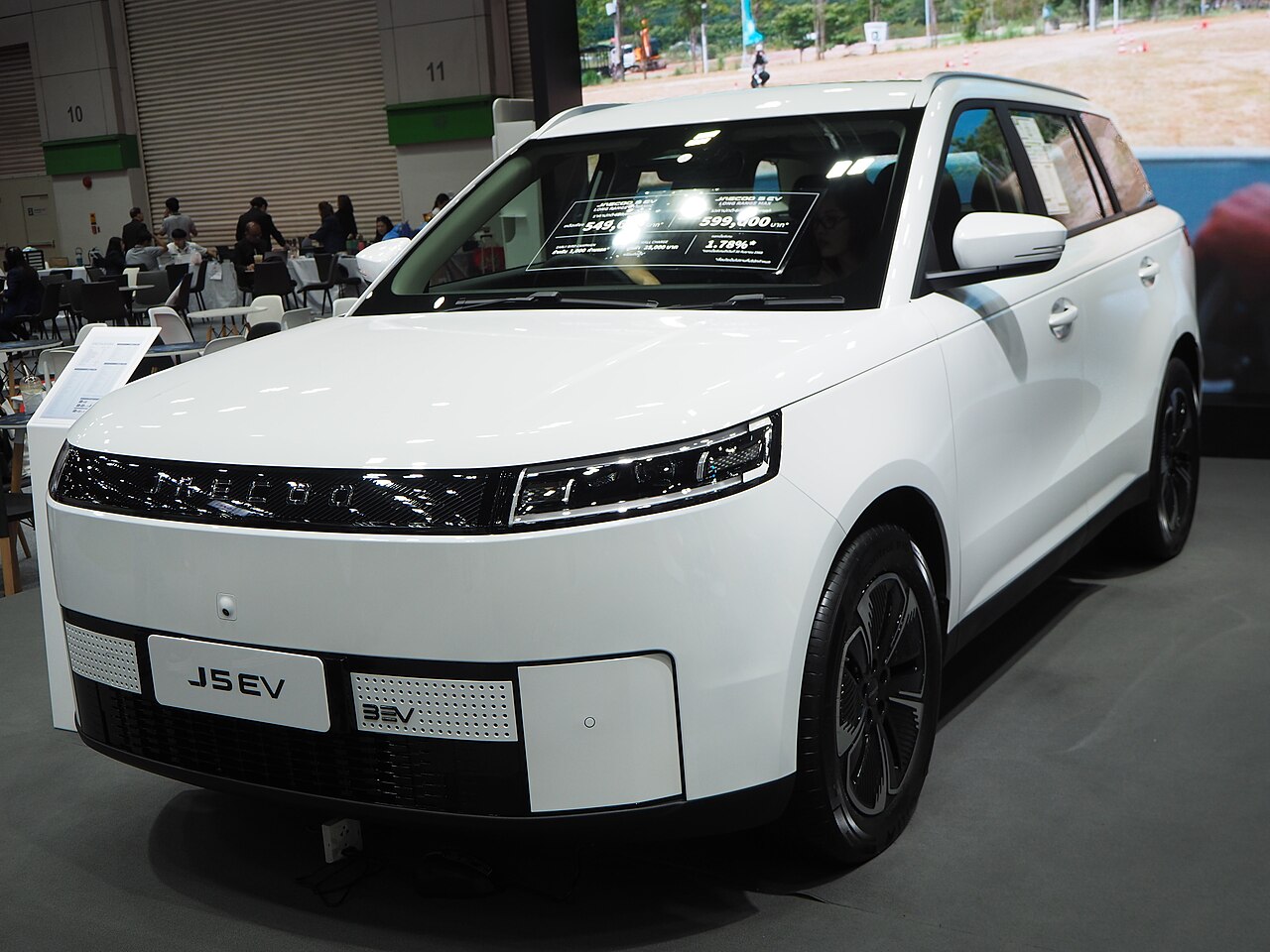
Top image: Photo: Chanokchon, CC BY-SA 4.0, via Wikimedia Commons

Indonesia’s local parts makers say the country risks hitting its tougher electric-car local-content target on paper while the most valuable components are still shipped in from abroad. The warning came on Wednesday (18 November) from the Indonesian Electric Vehicle Component Developers Forum (Forkindo), on the same day that Jaecoo and XPeng each said they would be ready for the 60% threshold that applies from 2027.
Under the government’s roadmap, battery-electric cars that receive incentives must reach a minimum local-content level (TKDN) of 40% until the end of 2026, 60% from 2027 to 2029, and 80% from 2030. Our TKDN explainer covers how the score is calculated and which incentives depend on it.
Assembly has moved, but the parts have not
Forkindo chairman Eddy Chan told Bisnis.com that the shift to local assembly is now clear. Citing Gaikindo figures, the outlet reported battery-electric wholesales of 117,218 units in January–September 2026, up 112.25% from 55,225 a year earlier, while Chan said imports of fully built (CBU) cars had fallen by almost 48%.
The question, he argued, is who supplies the parts. According to Forkindo, much of today’s TKDN score comes from assembling battery packs – the casing, protective structures and wiring harnesses – while high-value items such as battery cells, battery management systems, traction motors and inverters are still mostly imported.
“We don’t want TKDN to be achieved only on paper while the added value still flows abroad.” – Eddy Chan, Forkindo, to Bisnis.com (translated from Indonesian)
Chan noted that Indonesia already has an upstream base in nickel and battery projects such as Weda Bay, and a downstream base in vehicle assembly, but said the component industry linking the two remains thin.
Six proposals
Forkindo put forward six policy ideas:
- A TKDN calculation method that gives more weight to critical components, issued by mid-2027 at the latest.
- Incentives tiered by how deep the localisation goes, including TKDN conditions for hybrid and commercial-vehicle incentives.
- Closer links between upstream battery producers and local module and pack makers.
- Mandatory supplier-development programmes for carmakers that receive incentives, with financing support for component makers and small and medium-sized firms.
- Stronger testing and certification laboratories so local parts meet carmaker and export standards.
- Government and state-owned enterprise procurement that requires local components.
The group also proposed a joint working group with the Ministry of Industry before the end of the first quarter of 2027.
Jaecoo and XPeng say they are on track
Jaecoo, the Chery sub-brand that sells the J5 EV, said every model it builds and sells in Indonesia already meets the current 40% level. Head of product Ryan Ferdiean Tirto told detikOto that 60% next year is a realistic step and that localisation work across several components is under way, but he declined to say which parts will be made locally until production is running.
XPeng, which assembles its cars with PT Handal Indonesia Motor in Purwakarta, West Java, said its local line-up – the G6 (including the AWD version), X9 (including the AWD) and the recently launched G9L – averages above 40% TKDN, with some models at 44%. VP of marketing Hari Arifianto told detikOto the brand’s next gains would have to come from the battery side – packaging and the battery management system – and from local research and development.
That fits Forkindo’s diagnosis. XPeng’s packs come from PT UABS in Cikarang, a SAIC–CATL venture with local partner Kentjana Group that detikOto says can assemble up to 20,000 packs a year, while the cells themselves are not yet made locally. detikOto also reported that XPeng assembled 661 cars in Indonesia last year and 3,404 in January–September 2026.
Jaecoo and XPeng join a growing list of brands that have set out 60% plans in recent weeks, including Toyota, BYD, Wuling and GAC Aion.
What it means for buyers
For now, nothing changes at the showroom: the 40% rule applies until the end of 2026. From 2027, models that cannot show 60% risk losing the incentives tied to local content, which could push their prices up – XPeng’s Arifianto said the rule will strongly affect its selling prices. If Forkindo’s proposal to weight critical components more heavily is adopted, brands that rely mainly on local pack assembly could find 60% harder to reach. Buyers comparing models should watch for TKDN announcements alongside 2027 price lists, and can check which brands assemble locally in our EV directory.
Sources: Bisnis.com (18 Nov 2026); detikOto – Jaecoo (18 Nov 2026); detikOto – XPeng (18 Nov 2026).