
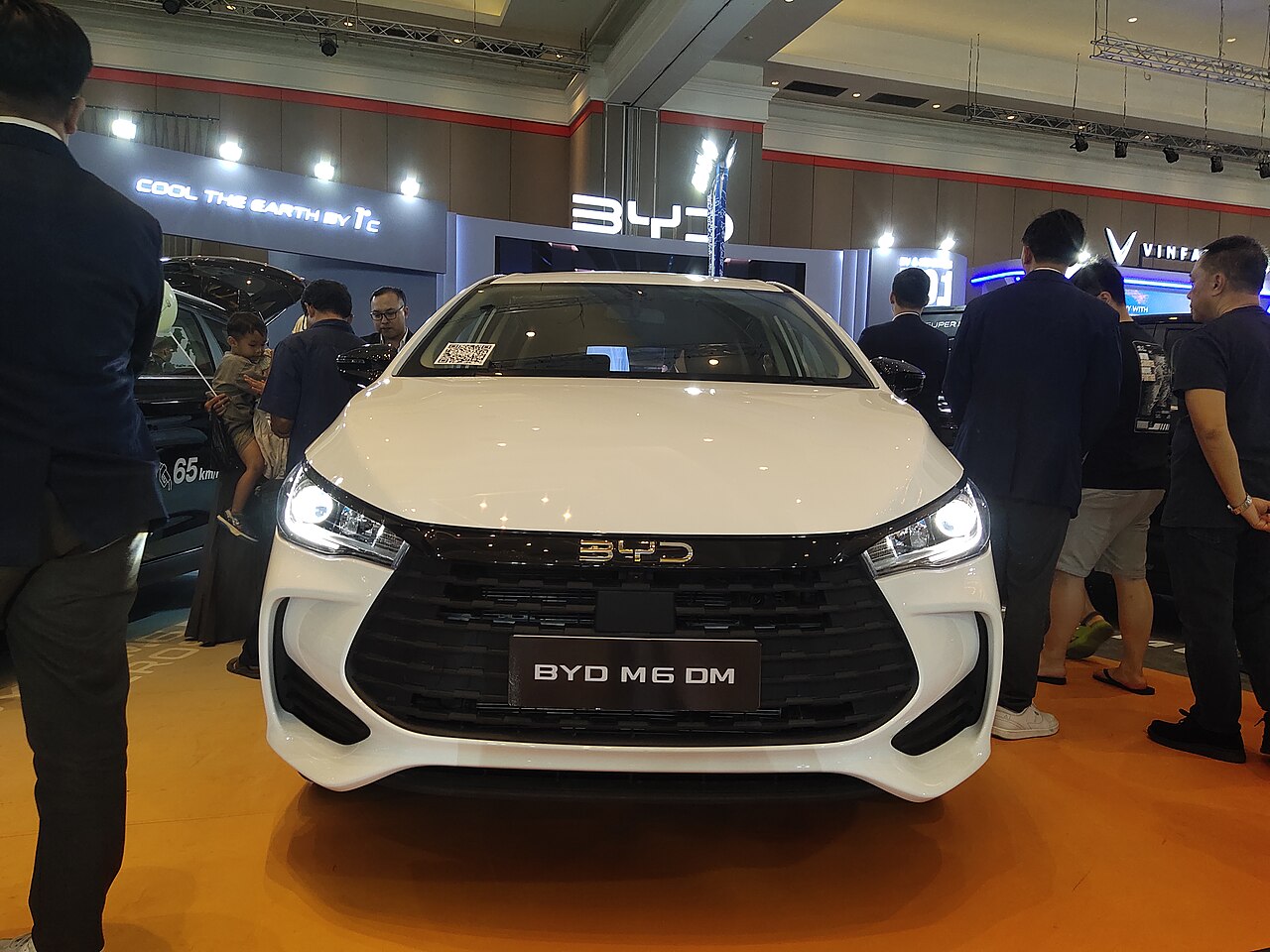
Top image: Photo: M Raisfath, CC BY 4.0, via Wikimedia Commons. The BYD M6 DM-i, Indonesia’s best-selling plug-in hybrid so far in 2026, at GIIAS in Bandung.

Walk into an Indonesian showroom in late 2026 and the word “electrified” can mean four quite different cars. Some never plug in, some plug in but still burn petrol most days, one type uses its engine only as a generator, and some have no engine at all. The government is now debating whether the three petrol-assisted types should get some of the perks that so far go only to full battery EVs. This guide explains how each works, how they are treated today and which suits which kind of driver.
The four types in plain terms
Hybrid (HEV)
A conventional hybrid pairs a petrol engine with an electric motor and a small battery that is charged by the engine and by braking. You fill it with petrol and never plug it in. The electric side mainly helps at low speeds and in stop-start traffic, which is where it saves the most fuel.
Plug-in hybrid (PHEV)
A PHEV has a much larger battery that you charge from the mains, so it can cover shorter trips on electricity alone before the engine takes over. Chinese brands often market these under their own names, such as BYD’s DM-i, Chery’s CSH or Jaecoo’s SHS. The fuel savings depend almost entirely on how often you charge it: an uncharged PHEV is simply a heavy hybrid.
Range-extended EV (REEV, sometimes EREV)
A REEV is driven only by its electric motor. It carries a battery that is large by plug-in standards and a petrol engine whose job is to generate electricity when the battery runs low, not to turn the wheels. KatadataOTO describes the driving experience as much closer to a pure EV than a PHEV. Changan’s Deepal S05 REEV, launched this year as the first REEV on sale in Indonesia, lists a pure electric mode, a range-extending mode in which the engine-driven generator tops up the battery, regenerative braking and a “camping mode” that runs the generator while the car is parked.
Battery electric vehicle (BEV)
A BEV has no engine and runs entirely on its battery, charged at home or at public SPKLU stations. It has the lowest running costs and the fewest moving parts, but it depends on you having somewhere reliable to charge. Our charging guide covers the options.
What Indonesians are actually buying
Gaikindo’s wholesale figures (factory-to-dealer shipments) for January to September 2026 show the battery EV has overtaken the hybrid:
- Battery EVs: 117,218 units, or 17.26% of a total market of 679,020, according to detikOto. Kompas gives a rounded figure of about 117,800 (17.3%); the small gap appears to come from different data cuts.
- Hybrids: 65,968 units, or 9.72% of the market (detikOto). Hybrids led electrified sales from 2021 to 2024 before BEVs surged in 2025 and 2026.
- Plug-in hybrids: 10,264 units, up 209.5% on the same period of 2025, led by the BYD M6 with 5,121 and the Chery Tiggo 8 CSH with 2,066 (CNN Indonesia). We covered the PHEV surge here.
- REEVs: still a niche. CNN Indonesia’s PHEV table counts 29 Deepal S05 REEVs over the nine months.
Our own calculation from these figures: battery EVs, hybrids and plug-ins together made up about 28.5% of all vehicles wholesaled in the first nine months.
How the rules treat each type today
Luxury tax. Under the luxury-tax regulation PP 74/2021, battery EVs are taxed on a 0% base, while plug-in hybrids and full hybrids pay luxury tax on a reduced share of their price, with the size of the reduction tied to fuel economy and emissions, as Gaikindo summarised when the rule was issued. The wider 2026 picture, including the end of the VAT discount and changes to regional vehicle tax, is in our EV tax and incentives guide.
Odd-even and other perks. In Jakarta, battery EVs are exempt from the odd-even number-plate restriction; hybrids, PHEVs and REEVs are not. The city is reviewing that rule, and some brands have warned against removing the EV exemption.
What may change. On 21 October Industry Minister Muhammad Sarmuji told Gaikindo that he wants non-fiscal incentives for hybrids, PHEVs and REEVs, including odd-even exemption and dedicated parking, and that tax relief is also being studied, though not necessarily at BEV levels (Koran Jakarta; our report is here). Nothing has been issued yet.
“The plug-in hybrid and REEV incentives will be formulated.” — Industry Minister Muhammad Sarmuji, to detikOto (translated from Indonesian)
Which one suits you?
- Choose a battery EV if you can charge at home or at work, most of your driving is in and around one city, and you want the lowest running costs and, in Jakarta, freedom from odd-even. Our running-cost comparison sets out what charging costs against petrol.
- Consider a REEV if you want to drive on electricity day to day but regularly travel where chargers are thin, such as long inter-city trips. Changan’s marketing head Ridjal Mulyadi told KatadataOTO that drivers covering about 170 km a day or less would run mainly on the battery. The choice is small: the S05 is priced in the Rp 500 million range.
- Consider a PHEV only if you will plug it in most days. It suits households that can charge but want a petrol fallback for family trips.
- Choose a hybrid if you cannot charge at all, for example in a flat or boarding house with no parking socket. You will still save fuel in traffic, with no change to how you refuel.
Things to check before you buy
- Your charging access, whether a home connection upgrade from PLN or a reliable SPKLU near your route.
- Battery warranty terms for BEVs, PHEVs and REEVs, including whether they transfer to a second owner.
- Your region’s vehicle tax. Exemptions are now set by each province, so check with your local Samsat or Bapenda.
- Policy timing. Past EV incentives have been tied to local-content thresholds, so if a hybrid or REEV scheme is announced, ask the dealer where the car is assembled.
Bottom line: the more reliably you can plug in, the further along the scale towards a full EV it makes sense to go.
Sources: detikOto, Oct 2026; CNN Indonesia, 19 Oct 2026; Kompas.com, 17 Oct 2026; KatadataOTO, 11 Jul 2026; Kompas.com (biz), 28 Apr 2026; Koran Jakarta, 21 Oct 2026; Gaikindo, PP 74/2021 summary.
Comments
2 responses to “Hybrid, PHEV, REEV or full EV: which suits drivers in Indonesia?”
[…] hybrids (PHEVs) and range-extender EVs (REEVs), which carry a petrol engine as a generator; our guide to hybrids, PHEVs, REEVs and full EVs explains the […]
[…] XPeng Indonesia will offer just one version: the battery-electric model with all-wheel drive. (Our guide to hybrids, PHEVs, REEVs and EVs explains the […]