
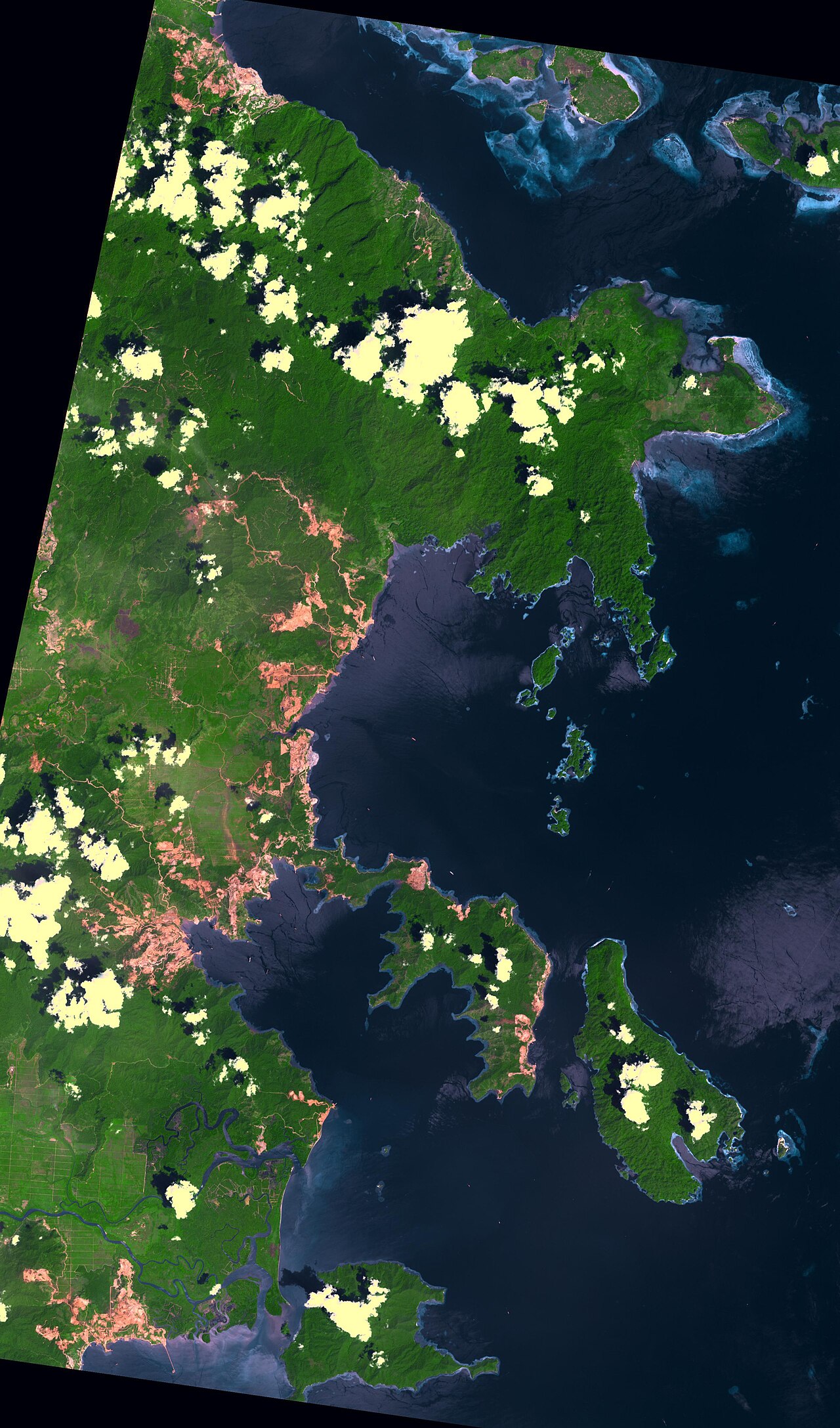
Top image: NASA/JPL, NASA/METI/AIST/Japan Space Systems and U.S./Japan ASTER Science Team, Public domain, via Wikimedia Commons. NASA satellite view of nickel mining in Southeast Sulawesi.

Indonesia now has a battery supply chain that runs all the way from nickel mines to finished battery cells, according to Bahlil Lahadalia, the coordinating minister for downstreaming and energy transition, who also serves as energy and mineral resources minister. In the same speech, however, he signalled that the government is reviewing whether new smelters making only semi-finished products should still be allowed, saying most of the industry is still stuck halfway up the value chain.
Bahlil was speaking on Monday 2 November at the opening of the Minerba Convention and Exhibition (Minerba Convex) 2026 at JIExpo Kemayoran in Jakarta, the same event at which economic council official Septian Hario Seto laid out the 60% local-content target for EVs in 2027.
“From mine to battery cell”
According to Antara and JawaPos, Bahlil said Indonesia was one of the countries that had managed to build an integrated car-battery ecosystem stretching from mining to battery cells. He pointed to three battery facilities: a plant in the Indonesia Weda Bay Industrial Park (IWIP) in Central Halmahera, North Maluku; the Hyundai LG Indonesia (HLI) Green Power cell plant in Karawang, West Java, which has been operating since July 2024; and the joint venture between state miner Antam and China’s CATL, which he said President Prabowo Subianto would inaugurate in Karawang this month. IndoEVs reported last week that Prabowo is expected to open the CATL-IBC plant.
Antara’s Indonesian service also quoted him as saying that the idea of an integrated battery ecosystem had been doubted when it was first presented in 2020, and that the United States now sources precursor and cathode material from Indonesia.
Export figures: sources differ
Bahlil used nickel exports to argue that halting raw ore exports had paid off, but the reports give different numbers. JawaPos, carrying Antara copy, says exports grew from US$3.3 billion in 2017 to US$40 billion in 2025, with US$25.96 billion recorded by the Directorate General of Minerals and Coal up to August 2026. Antara’s Indonesian report and Kumparan put the post-ban level at about US$34 billion, compared with US$3.3 billion in 2017–2019, without naming a year. The gap may reflect different years or definitions; the ministry has not clarified it.
A rethink on smelters
The more consequential part of the speech may be the warning about where processing has stalled. Bahlil said most downstream output was still at the intermediate stage, around 50–60% of the full value chain, and described the number of smelters as having “boomed”. Antara reported that the government is weighing whether smelters that produce only semi-finished goods should still be built, or should face further regulation.
“What we need to push is the end product, so that semi-finished raw materials are not all exported abroad.” – Bahlil Lahadalia, quoted by Antara (translated from Indonesian)
Tri Winarno, director general of minerals and coal, said the next phase should cover intermediate materials and components, including for the battery industry. Bahlil also stressed, as reported by Media Nikel Indonesia, that downstreaming must be “equitable”, with benefits reaching communities around mining areas, not only higher commodity value and state revenue.
The review builds on the option of a moratorium on new semi-finished nickel smelters that Bahlil raised in October, and comes as some Chinese nickel producers weigh output cuts.
What it means for buyers
For drivers, a mine-to-cell chain matters mainly through local content rules. With the TKDN threshold for battery EVs set to rise to 60% next year, carmakers that can buy locally made cells, such as those from HLI or the CATL joint venture, should find it easier to qualify for incentives and keep prices competitive. Whether incentives should favour nickel-based cells over nickel-free LFP (lithium iron phosphate) batteries remains a point of debate. The environmental footprint of the nickel parks, many of which run on captive coal power, is another open question. Hyundai, whose cell plant Bahlil cited, is listed in our EV directory.
Sources: Antara (English); Antara (Indonesian); Kumparan; JawaPos; Media Nikel Indonesia.