
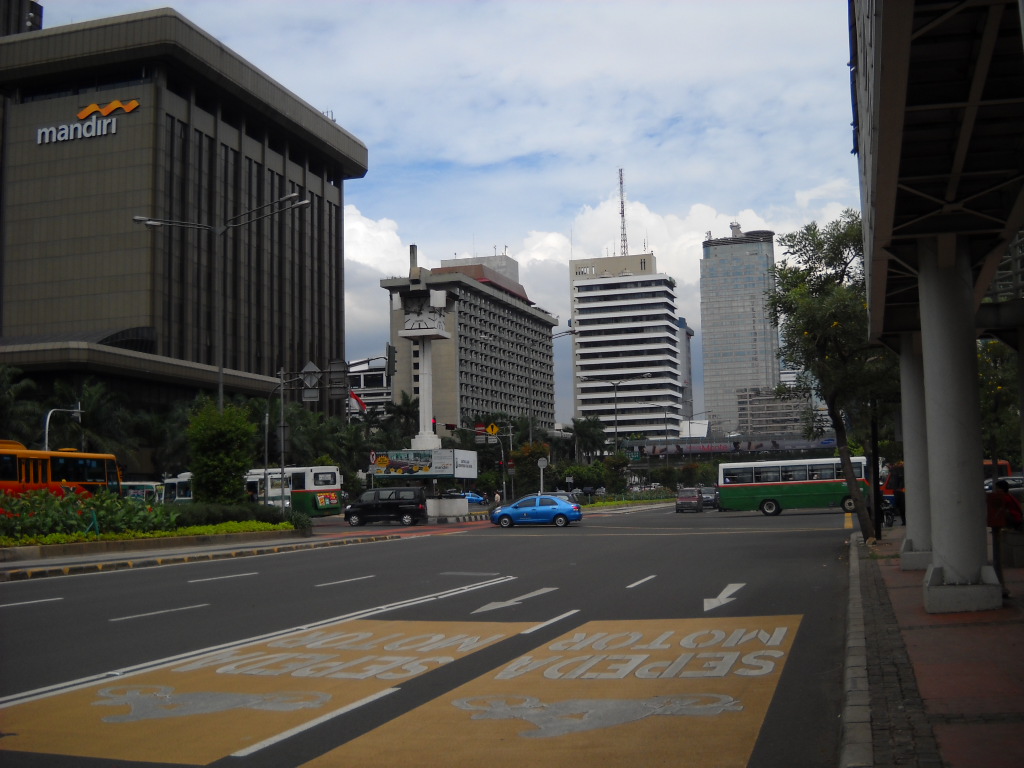
Top image: Photo: Taman Renyah, CC BY 3.0, via Wikimedia Commons

For many Jakarta drivers, the single most practical reason to choose a battery electric car is not the tax break or the running costs. It is being able to drive into the city centre on any weekday, whatever the last digit of the number plate. That perk comes from Jakarta’s odd-even (ganjil genap) traffic restriction, and it is now under review.
This guide explains how the rule works, which vehicles are exempt, why hybrids do not qualify, what happens if you break it, and how the current debate could affect anyone thinking of buying an EV.
How the odd-even rule works
The scheme is set out in Jakarta Governor Regulation (Pergub) No. 88 of 2019, which amended an earlier 2018 regulation, according to a summary of the current rules published by Harian.news in August. The basics:
- Days: Monday to Friday only. It does not apply on Saturdays, Sundays or national public holidays.
- Hours: two sessions, 06:00–10:00 and 16:00–21:00 Western Indonesian Time (WIB).
- Plates: cars whose plate ends in an odd digit (1, 3, 5, 7, 9) may use the restricted roads on odd-numbered dates; those ending in an even digit (0, 2, 4, 6, 8) on even-numbered dates.
The restriction covers private four-wheeled vehicles on specified corridors, not the whole city. Outside the listed roads and hours, any car can drive as normal.
Which roads are covered
Harian.news lists 25 road sections, concentrated on Jakarta’s main north–south and east–west arteries. They include:
- Central spine: Jalan M.H. Thamrin, Jalan Jenderal Sudirman, Jalan Medan Merdeka Barat, Jalan Sisingamangaraja, Jalan Panglima Polim and Jalan Fatmawati (between Jalan Ketimun 1 and Jalan T.B. Simatupang).
- Old town and the north: Jalan Pintu Besar Selatan, Jalan Gajah Mada, Jalan Hayam Wuruk, Jalan Majapahit, Jalan Gunung Sahari and Jalan Stasiun Senen.
- Business districts and the inner ring: Jalan Gatot Subroto, Jalan H.R. Rasuna Said, Jalan M.T. Haryono, Jalan D.I. Panjaitan, Jalan Jenderal S. Parman (Tomang Raya to Gatot Subroto) and Jalan Jenderal A. Yani (Bekasi Timur Raya to Perintis Kemerdekaan).
- West and east links: Jalan Suryopranoto, Jalan Balikpapan, Jalan Kyai Caringin, Jalan Tomang Raya, Jalan Pramuka, Jalan Salemba Raya and Jalan Kramat Raya.
If you commute along Sudirman–Thamrin or the Gatot Subroto–Rasuna Said business belt, the rule is likely to affect you on half of all working days.
Who is exempt
Medcom.id lists 13 categories of vehicle that are not bound by the rule. For private motorists the relevant ones are:
- electric vehicles;
- motorcycles, which are outside the scheme altogether, so electric motorbikes are unaffected either way;
- cars carrying people with disabilities (with the appropriate sticker).
The remaining categories cover emergency and official traffic: ambulances, fire engines, yellow-plate public transport, fuel tankers, red-plate government vehicles, military and police vehicles, vehicles of senior state officials and visiting foreign dignitaries, accident-recovery vehicles, supervised cash-in-transit vans, and vehicles granted discretion by the police.
Only battery electric cars qualify
The EV exemption applies to vehicles powered solely by electricity. As GridOto has explained, conventional hybrids still use a petrol engine, so they are not covered. The same logic applies to plug-in hybrids (PHEVs) and range-extender EVs (REEVs), which carry a petrol engine as a generator; our guide to hybrids, PHEVs, REEVs and full EVs explains the differences.
Battery electric cars are identified by their number plate, which carries a blue strip along the validity-date section. There is no separate sticker to apply for: if your car is registered as a battery EV, the plate itself signals the exemption to officers and cameras.
Fines and enforcement
Breaking the rule is treated as ignoring a traffic sign under Law No. 22 of 2009 on Road Traffic and Transport. Harian.news cites Article 287, which allows a fine of up to Rp500,000 or up to two months’ imprisonment. Police enforce the rule both with officers at the roadside and through ETLE electronic cameras, Sinergianews reports.
Is the EV exemption going to end?
Not yet, but it is no longer guaranteed. The rule has been in place for roughly a decade, and in late September the Jakarta Transportation Agency held a focus group discussion to evaluate it. The agency is studying its economic and emissions effects, how vehicles should be classified, and which roads should be covered.
Speaking at City Hall on 30 September, agency head Budi Awaluddin said simply: “There has been no change yet,” Antara reported (translated from Indonesian). He added that the scheme has been effective at reducing congestion and needs further study. Suara.com framed the dilemma: the exemption helps EV sales, but a fast-growing EV fleet using the restricted corridors freely could bring congestion back.
Since then the debate has moved in two directions at once:
- Extending the perk: Industry Minister Muhammad Sarmuji has proposed incentives for hybrids, PHEVs and REEVs that include odd-even exemption. We covered his proposal here. Carmakers such as Honda and Chery have argued for the same thing before, detikOto reported in 2025.
- Phasing it out eventually: Periklindo chairman Moeldoko has suggested the EV exemption could end once EVs reach around 30% of the vehicle population, a level still far off (our report). Sarmuji has said he will hear Periklindo’s full case before taking a view (follow-up).
Leapmotor, among other brands, has warned that removing the exemption could dent demand (background here). As of 1 November no change to the regulation has been announced, so battery EVs remain exempt.
What it means for buyers
- If you drive restricted corridors daily, a battery EV currently doubles the weekdays you can use them at peak times compared with a petrol car or hybrid. That is a real convenience, but treat it as a bonus rather than a permanent right when weighing up a purchase.
- Do not buy a hybrid or PHEV expecting the exemption. Proposals to extend it are only proposals; under the current regulation they must follow the odd-even rule.
- Check the plate on a used EV. The blue strip should be present and the registration should show an electric power source.
- Look at the full cost picture. Tax, charging and depreciation matter more over several years than one traffic perk. Our guides to EV taxes and incentives and electric car prices and models cover those.
- On two wheels, the rule does not apply to motorbikes at all, so an electric motorbike gains nothing extra here.
We will update this guide if Jakarta changes the regulation or its list of exempt vehicles.
Sources: Harian.news; Medcom.id; GridOto; Sinergianews; Antara; Suara.com; detikOto.