
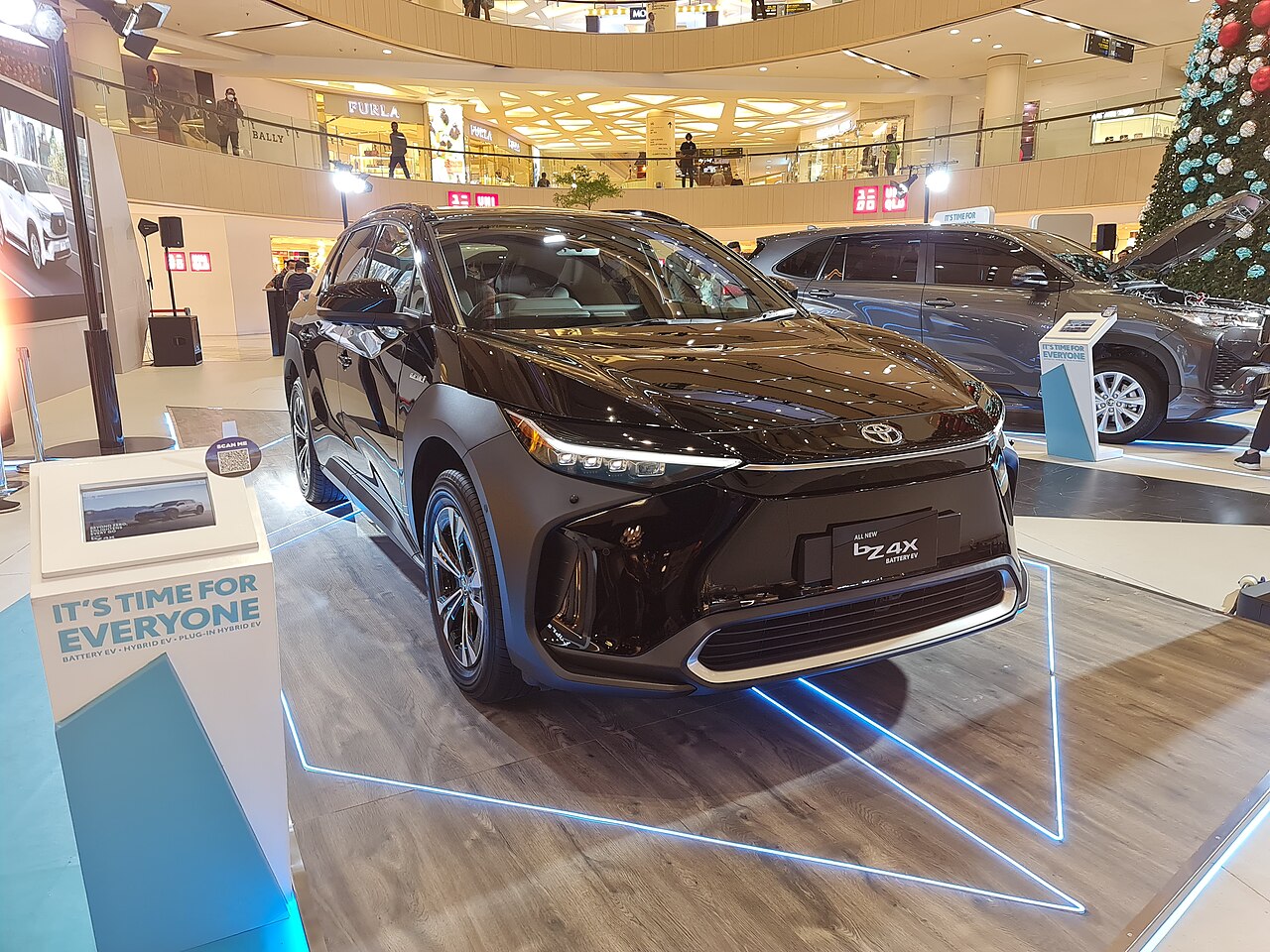
Top image: Photo: Alex Neman, CC BY-SA 4.0, via Wikimedia Commons

Toyota’s Indonesian sales arm says the brand will comply with the higher local-content threshold for electric cars that takes effect in 2027, even though its only locally assembled battery EV, the bZ4X, currently sits well below it.
Speaking in Tangerang on Friday 13 November, PT Toyota Astra Motor (TAM) marketing director Ernando Demily said the company would adjust next year to the 60% tingkat komponen dalam negeri (TKDN) requirement that applies to EVs receiving government incentives, KatadataOTO reported.
“Once the government sets the rules, we at Toyota will certainly follow them.” – Ernando Demily, Toyota Astra Motor, to KatadataOTO (translated from Indonesian)
The comments follow BYD telling the industry minister it could reach 60% local content and Wuling saying five of its EVs were already at that level.
Where the bZ4X stands
According to Ernando, the bZ4X has a TKDN rating of 40%, in line with the rules now in force. It is assembled at Toyota Motor Manufacturing Indonesia (TMMIN) in Karawang, while Toyota’s other battery EV on sale, the Urban Cruiser, is imported fully built from India. He added that Toyota’s hybrid line-up can reach around 80% local content and that hybrid batteries are already produced in Indonesia.
The key to lifting the bZ4X’s score, he said, is battery assembly and battery components, noting that all battery-EV makers are moving towards assembling packs locally.
That is a firmer tone than Toyota struck earlier in the autumn. At the end of September, TMMIN deputy president director Nyoman Winaya told Katadata the company was still studying the target and discussing it with the government. In mid-October, TMMIN president director Nandi Julyanto told Kontan that reaching 60% would require local production of key components, particularly batteries. He said Toyota already works with CATL on hybrid batteries, that the main differences for a BEV pack are the number of cells and the battery management system, and that the company was consulting its Japanese headquarters while preparing a fallback scenario in case 60% could not be reached on time. He also said Toyota remained committed to building the bZ4X locally from kits (CKD).
Japanese makers have voiced wider concerns. The Jakarta Post reported in September that TMMIN, Denso, Aisin and Advics raised issues including licensing, financing for smaller suppliers and local-content certification at a meeting with Indonesian officials in Nagoya.
How the rule works
Under the current roadmap, battery-electric cars need 40% local content for 2022–2026, 60% for 2027–2029 and at least 80% from 2030, according to Katadata. Katadata listed battery-related weightings of 10% for local battery-pack assembly, 20% for producing housings and wiring harnesses, and 30% for a locally made battery management system. Sources differ on the legal basis: Katadata cites Presidential Regulation 79/2023, while the Jakarta Post cites Industry Ministry Regulation 6/2022. Our TKDN explainer and earlier report on the battery-pack requirement cover the background, and our previous story on the industry minister pressing Toyota to go fully electric sets out the political pressure on the brand.
What it means for buyers
KatadataOTO puts the bZ4X at Rp 799 million on the road in Jakarta, with the larger bZ4X Touring, which debuted at GIIAS 2026, at Rp 889 million. The standard car has a 73.11 kWh battery with a claimed 525 km range; the Touring has a 74.96 kWh pack and up to 487 km.
Because the 60% threshold is tied to incentive eligibility, our reading is that a bZ4X that has not reached it by 2027 could lose access to those incentives, which may put pressure on its price. Toyota has not given a date for a higher-content bZ4X or said whether prices would change. Buyers weighing the car now may want to ask dealers how 2027 stock will be classified. Toyota’s line-up and prices are listed in our EV directory entry for Toyota.
Sources: KatadataOTO (14 Nov 2026); Kontan (15 Oct 2026); Katadata (30 Sep 2026); The Jakarta Post (22 Sep 2026)