
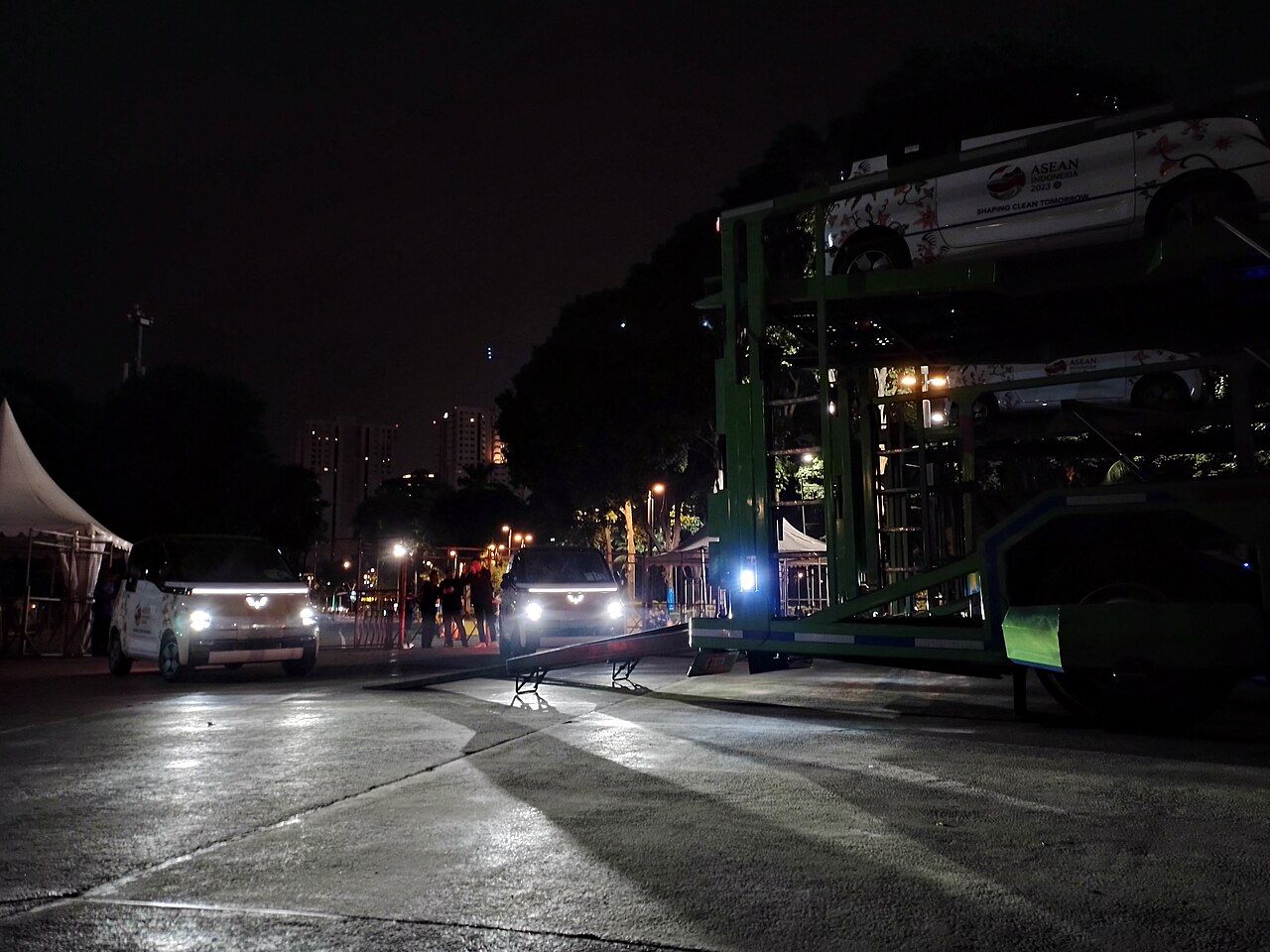
Top image: Photo: RasyaAbhirama13, CC BY-SA 4.0, via Wikimedia Commons

Electric cars sold in Indonesia will need at least 60% local content from next year, and their battery packs will have to be assembled in the country, according to Septian Hario Seto, executive secretary of the National Economic Council (DEN). Speaking at the Minerba Convention & Exhibition 2026 at JIExpo in Jakarta on Tuesday, Seto said the bar would rise again later in the decade to a level that forces carmakers to source battery cells locally, CNBC Indonesia reported.
The comments are the clearest signal yet that the government intends to stick to the higher local-content threshold (TKDN) for battery electric vehicles in 2027, after weeks of debate over incentives, hybrids and nickel-based batteries.
From 40% to 60%, then 80%
Under the current rules, a battery EV needs at least 40% local content to qualify for Indonesia’s EV programme. Seto said that figure would step up to 60% next year, together with an obligation to turn imported or local cells into finished battery packs on Indonesian soil.
He added that the requirement would reach 80% by 2029 – a date he gave with the caveat “if I’m not mistaken”. At that level, the battery cell itself must be produced domestically. “At 80%, the battery cells have to be made in Indonesia,” he said (translated from Indonesian).
The timetable he described differs slightly from the one presented by the Ministry of Industry. In a September hearing with House Commission VII, cited in the same CNBC Indonesia report, Setia Diarta, director general of metal, machinery, transport equipment and electronics industries (ILMATE), set out a minimum of 40% until 2026, 60% for 2027–2029 and at least 80% from 2030. He said the industry would have to start making battery packs and modules locally so that finished batteries no longer need to be imported, and described the cell as the component that matters most for the TKDN score.
Industry Minister Muhammad Sarmuji struck a confident note last week. Manufacturers that produce in Indonesia and use domestic components should be able to meet 60% by 2027, he said, according to Antara, adding that the government would push for technology transfer and monitor compliance.
Why the government wants it
Seto framed the TKDN path as a way to give investors predictable rules, arguing that Indonesia should avoid the kind of regulatory instability Thailand has experienced. He put national electric car sales last year at about 100,000 units, which he said places Indonesia among the world’s 20 largest EV markets.
The battery requirement is also tied to Indonesia’s nickel strategy. Setia said downstream processing had already reached nickel sulphate and cobalt sulphate, and that the focus from 2026 to 2030 would shift to cathode and anode materials. Cell production capacity is starting to arrive: President Prabowo is due to open the CATL-IBC battery plant in Karawang, which would give carmakers a local source of cells.
For brands already assembling locally, the step looks manageable. BYD has said its Subang-built cars already exceed 40% and that it is targeting 60% for 2027, while the ministry has suggested that even models that started life as imports could reach 60% with local batteries. The harder test will be the later move to locally made cells.
Incentives still unresolved
The local-content rules arrive while the industry is still waiting for clarity on incentives. Harry Yanto, vice president of operations at Kia Sales Indonesia, told reporters on 28 October that he expects the battery EV market to be flat in 2027 if no new support is introduced, CNN Indonesia reported. “Without attention from the government on this subsidy, prices will certainly be higher,” he said (translated from Indonesian). Kia is widening its line-up with hybrids and possibly plug-in hybrids in response.
Several new incentive schemes have been discussed this year, including the proposal for bigger incentives for nickel-battery cars, but none had been implemented at the time of CNN Indonesia’s report.
What it means for buyers
- More locally assembled models: brands that want to stay in the EV programme will need local battery-pack lines, which favours makers with Indonesian plants such as BYD and Wuling.
- Possible price pressure: localisation costs money up front, and with incentives still undecided, some brands warn prices could rise. Check our EV directory for current models and prices.
- Longer term: local battery packs and, later, cells could make servicing and battery replacement easier to arrange in Indonesia.
Official regulations setting out the 2027 threshold, including the exact start date and transition rules, had not been published at the time of writing.
Update (5 November 2026): Hyundai says its Indonesian-built Neira seven-seater will clear the new threshold. Read our follow-up.
Update (6 November 2026): Wuling now says five of its Indonesian-built EVs hold a 60% rating, while economists at INDEF warn the rule must build real suppliers rather than paperwork. Read the follow-up.
Sources: CNBC Indonesia (3 Nov 2026); Antara News (29 Oct 2026); CNN Indonesia (30 Oct 2026)
Comments
One response to “EVs must hit 60% local content with locally built battery packs from 2027”
[…] Bahlil was speaking on Monday 2 November at the opening of the Minerba Convention and Exhibition (Minerba Convex) 2026 at JIExpo Kemayoran in Jakarta, the same event at which economic council official Septian Hario Seto laid out the 60% local-content target for EVs in 2027. […]