
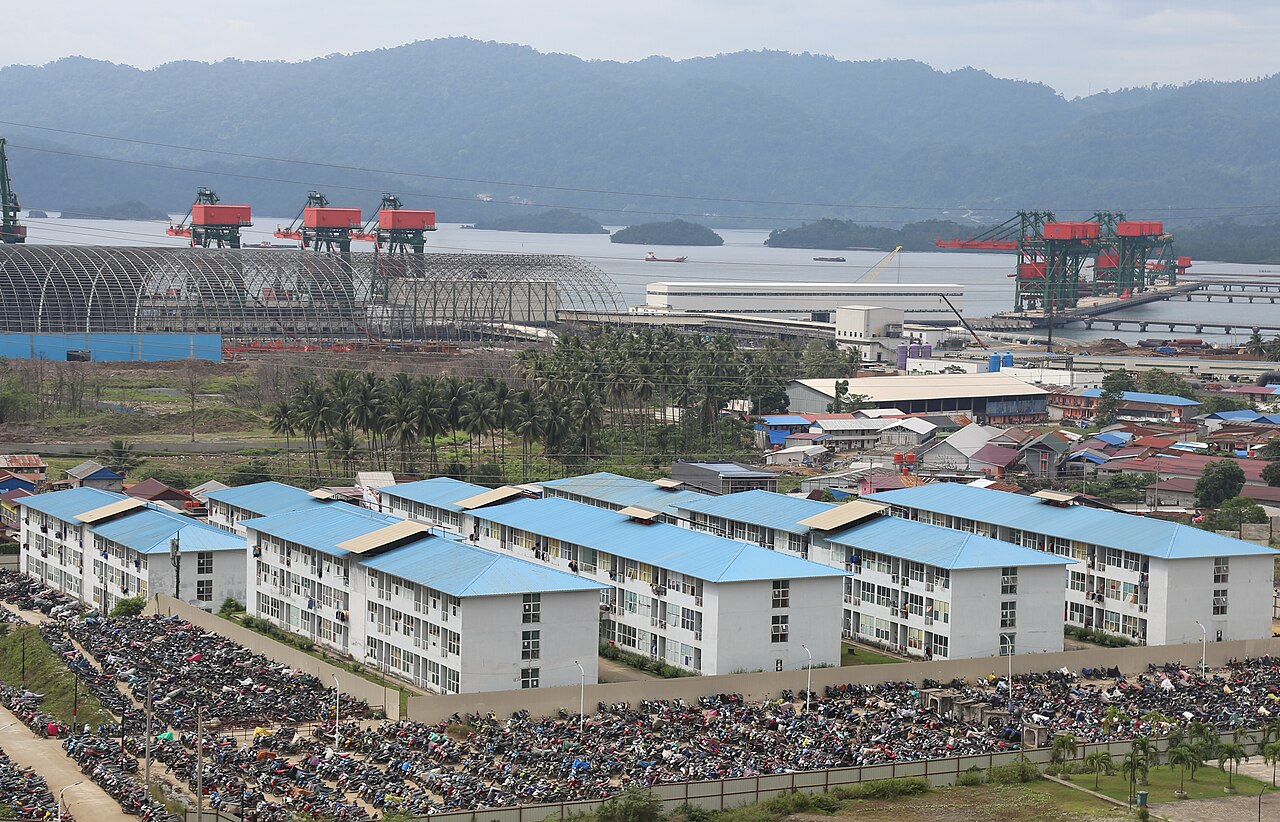
Top image: Photo: Ministry of Public Works of Indonesia (Kementerian PUPR), Public domain, via Wikimedia Commons

Indonesia’s two biggest nickel processing hubs now have around 15.9 gigawatts (GW) of power capacity, most of it from coal plants the parks build and run for themselves. Energy experts quoted by Kontan on Sunday 11 October warned that this reliance on so-called captive coal power could weaken the appeal of the country’s nickel and EV battery materials in export markets that increasingly check carbon footprints.
The debate follows last week’s ceremony at the Indonesia Weda Bay Industrial Park (IWIP) in North Maluku, where President Prabowo Subianto marked Indonesia’s first EV battery exports and the start of 11 industrial projects.
Where the 15.9 GW figure comes from
At the IWIP groundbreaking on Thursday 8 October, Investment and Downstreaming Minister and Danantara CEO Rosan Roeslani said installed and under-construction power capacity at IWIP exceeds 7.1 GW, while the Indonesia Morowali Industrial Park (IMIP) in Central Sulawesi has about 8.8 GW. He put the combined total at roughly 15.9 GW and compared it with Singapore’s total electricity use of 13.1 GW, according to Antara and Kontan.
Antara’s report of the event put the 11 projects at US$10.2 billion. They include nickel-based battery materials, battery separators and electrolytes, aluminium smelting, electric mining trucks and solar glass. Antara did not describe the parks’ power mix. Kontan’s reporting says the capacity is dominated by captive coal-fired plants (PLTU captive), which operate outside the state utility PLN’s grid.
Why smelters build their own coal plants
Muhammad Kholid Syeirazi, a member of the National Energy Council (DEN), told Kontan that investors choose captive coal because it is seen as cheap, reliable and can be built anywhere, including areas PLN’s grid does not reach. Smelters need gigawatt-scale power that runs around the clock, and he said PLN’s systems in some industrial regions cannot yet supply that.
“If industrial expansion continues to be powered by captive coal plants, the Net Zero Emission 2060 target could be missed.”
— Muhammad Kholid Syeirazi, DEN, to Kontan (translated from Indonesian)
He called for all new captive capacity to be written into the national energy and electricity plans (RUEN, RUKN and PLN’s RUPTL) so it can be tracked against transition goals. He also noted that global buyers increasingly look at the carbon footprint of nickel, steel, aluminium and EV battery materials, and that high-emission products could face trade barriers and higher compliance costs.
Saleh Abdurrahman of the Indonesian Renewable Energy Society (METI) told Kontan that large industrial users usually build their own plants when PLN cannot guarantee the capacity and reliability they need. He said the government’s planned 100 GW solar programme would make net-zero commitments more credible if it is delivered, but that it still needs clear buyers for the power.
Stranded-asset and revenue concerns
Yusuf Rendy Manilet, a researcher at the Center of Reform on Economics (CORE), told Kontan that state revenue from the parks does not rise in step with export values, because of fiscal incentives, imported capital goods and profits sent abroad. He said the net benefit shrinks further once health, pollution and carbon costs are counted. He also pointed out that current rules still exempt captive coal plants linked to national strategic projects.
He warned that high-carbon nickel could lose access to premium markets or face price penalties. He also said the coal plants being built now “have operating lives of decades, so they risk becoming stranded assets” (translated from Indonesian). His suggestions included requiring new smelters to use renewable or hybrid power, and opening “power wheeling” so parks can buy green electricity through PLN’s network.
What it means for buyers
For Indonesian EV buyers, nothing changes at the showroom today. Only a handful of EVs on sale locally use nickel-based batteries, as Suara noted earlier this year, so the parks’ power mix has little direct bearing on what most local buyers drive. The issue matters more for the bigger picture: whether Indonesia’s nickel-to-battery strategy, outlined in our battery industry guide, can produce materials that carmakers and overseas regulators regard as low-carbon. That will shape how much battery investment and value-added work stays in Indonesia, alongside the 60% local-content rule due from 2027.
Update, 14 October 2026: the government is now weighing a moratorium on new smelters that make semi-finished nickel. Read more: Indonesia weighs halt to new semi-finished nickel smelters amid glut.
Sources: Kontan – DEN on captive power (11 Oct 2026); Kontan – METI on industrial power demand (11 Oct 2026); Kontan – CORE on nickel exports (11 Oct 2026); Antara – 11 industrial projects worth US$10.2 billion (8 Oct 2026)
Comments
One response to “Nickel parks’ 15.9 GW power base, mostly coal, raises EV battery questions”
[…] Follow-up: Experts have since raised questions about the coal-heavy power supply behind the Weda Bay and Morowali parks. Read Nickel parks’ 15.9 GW power base, mostly coal, raises EV battery questions. […]