
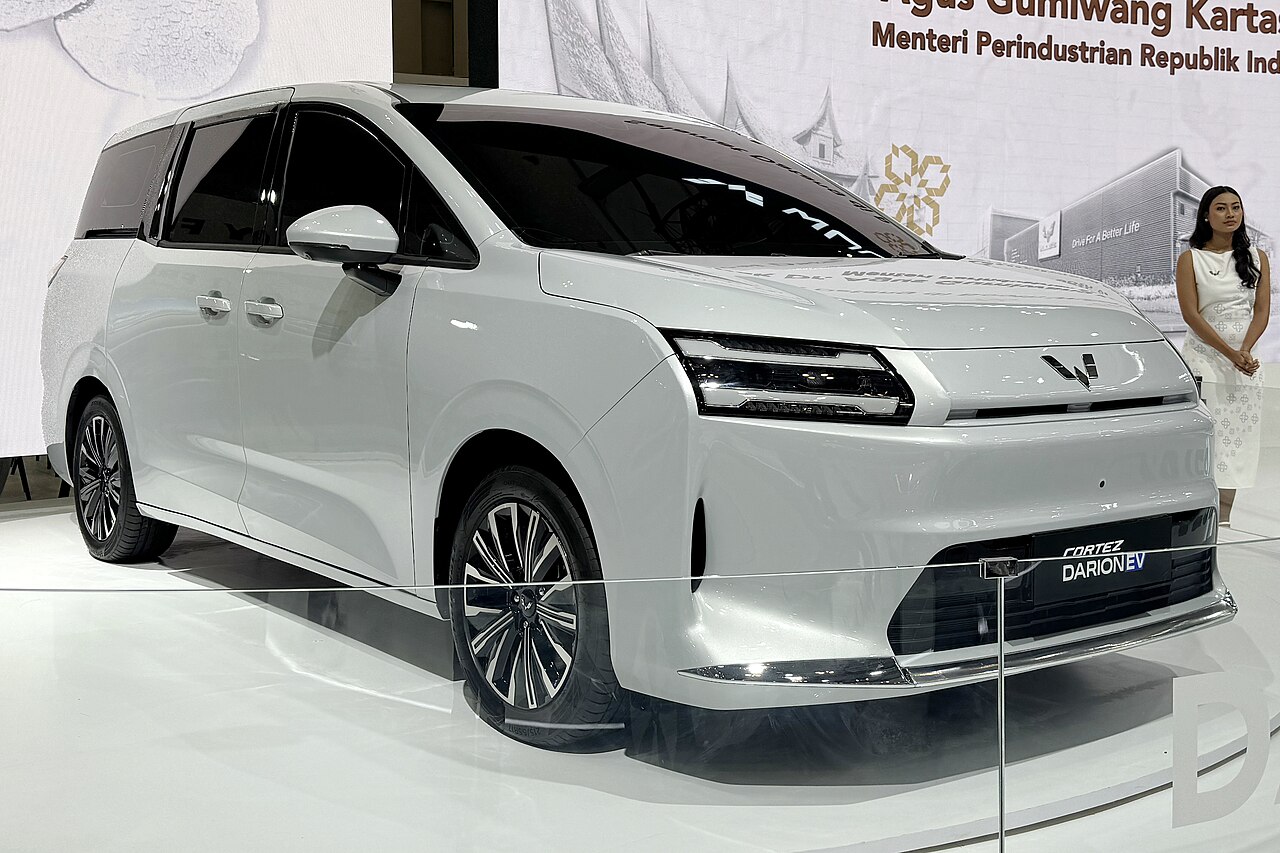
Top image: Photo: Andra Febrian, CC BY 4.0, via Wikimedia Commons

Indonesia’s Ministry of Industry has restated that locally built battery-electric vehicles will need to reach 60% local content (TKDN) from 2027, rising to 80% from 2030. Officials also said electric cars now make up 16% of the domestic market, and that EVs could overtake combustion-engine vehicles within the decade.
The comments came at a forum on Wednesday 30 September titled “Powering Indonesia Future: Green Cars, Blue Skies”, CNN Indonesia reported. They come two days after the parts makers’ association GIAMM warned that the current rules leave little room for local suppliers.
The timetable
Patia J. Monangdo, head of the ministry’s working team for battery-based electric vehicles, set out the staged requirements. According to CNN Indonesia, the minimum local-content levels for electric cars are:
- 2019–2021: 35%
- 2022–2026: 40%
- 2027–2029: 60%
- 2030 onwards: 80%
Similar stages apply to electric two- and three-wheelers, the report said.
“The roadmap for 2026 is currently 40 per cent; from 2027 to 2029 it will be 60 per cent.” – Patia J. Monangdo, Ministry of Industry, to CNN Indonesia (translated from Indonesian)
None of this is a new rule. The 60% level was first due in 2024 under Presidential Regulation 55/2019. It was pushed back to 2027 by Presidential Regulation 79/2023, signed in December 2023. That revision also exempted vehicles converted to electric power by certified workshops. It also said that companies which imported cars under the incentive scheme must build locally to the TKDN schedule, or repay an amount equivalent to the incentives they received.
What the forum did show is that the government is not planning another delay. With 2027 only three months away, car makers have little time left to close the gap. According to CNN Indonesia, the average TKDN score for EVs in Indonesia is currently 45–47%. The highest is 80%, and more than 100 EV products have been certified. In July, Patia told Viva that one model had already reached 80%.
EV share climbs to 16%
Patia also gave new figures on how fast the market is growing. He said electric vehicles’ share of sales had been only around 2–3% previously, reached about 12% in 2025 and stands at 16% so far this year, Portal Media and CNN Indonesia reported. The reports did not say whether the figure covers only battery-electric cars or also includes hybrids. It is also not clear which sales measure it is based on, so it may not match Gaikindo’s monthly data exactly.
He said Indonesia can produce almost 1.5 million motor vehicles a year. He also argued that the country’s nickel reserves should bring investment across the whole battery chain, from nickel processing and cathode and anode production to cell making and recycling. We cover this in our guide to Indonesia’s battery industry. The ministry says it will help component makers with certification, technical training and competency standards so that they can join EV supply chains.
Overtaking petrol cars “by 2029–2031”
Deputy Industry Minister Faisol Riza went further. CNN Indonesia reported that under the ministry’s fast-growth scenario, EVs could outnumber combustion-engine (ICE) vehicles in 2029–2031. Under a moderate scenario, battery-electric vehicles would overtake ICE in 2032–2034. He said the projection does not yet take hybrids and plug-in hybrids into account. The report’s headline refers to the vehicle “population”, but it does not explain whether the ministry means annual sales or the total number of vehicles on the road. The difference is large. With EVs at 16% of sales today, it would take much longer for them to outnumber ICE vehicles on the road than for them to outsell them.
What it means for buyers
- Local content is the price lever to watch. Indonesia’s EV incentives have been tied to TKDN thresholds, and the e-motorbike subsidy now under discussion also requires at least 40% local content, OtoDream reports. If car makers cannot reach 60% by 2027, and incentives stay linked to the minimum level, prices of some models could come under pressure unless makers use more local parts or change their line-ups.
- Imported models are most exposed. Brands that entered with imported (CBU) cars under the incentive scheme have committed to local production. Buyers of those models may see changes in which variants are offered and how much they cost as local assembly begins.
- Nickel-based batteries could become more common. The ministry’s focus on nickel suggests the government wants more nickel-based batteries in future locally built EVs.
For current prices and models, see our electric car buying guide and the IndoEVs directory.
Update, 13 October 2026: the ministry now says brands without an Indonesian assembly plant could still reach 60% by using locally made batteries. Read our follow-up.
Sources: CNN Indonesia – TKDN rules; CNN Indonesia – TKDN roadmap; CNN Indonesia – 16% market share; CNN Indonesia – EV vs ICE projection; Portal Media; Viva (July 2026); OtoDream – e-motorbike incentive.
Comments
4 responses to “Ministry reaffirms 60% EV local-content rule from 2027 as EV share hits 16%”
[…] Update, 30 September: The Ministry of Industry has confirmed that the requirement will rise to 60% local content from 2027 and 80% from 2030. Read our follow-up. […]
[…] wrinkle to the tightening TKDN (domestic component level) rules that we covered when the ministry reaffirmed the 60% threshold at the start of the […]
[…] more cells and battery materials made in Indonesia would make it easier for carmakers to meet the 60% local-content requirement from 2027, which decides whether EVs qualify for tax incentives. Whether batteries made at Weda Bay end up in […]
[…] 40% local content through 2026, rising to 60% from 2027 and 80% from 2030, as the Industry Ministry restated this week. Parts makers have warned that the 2027 step will be hard to meet without local battery cells, as […]