
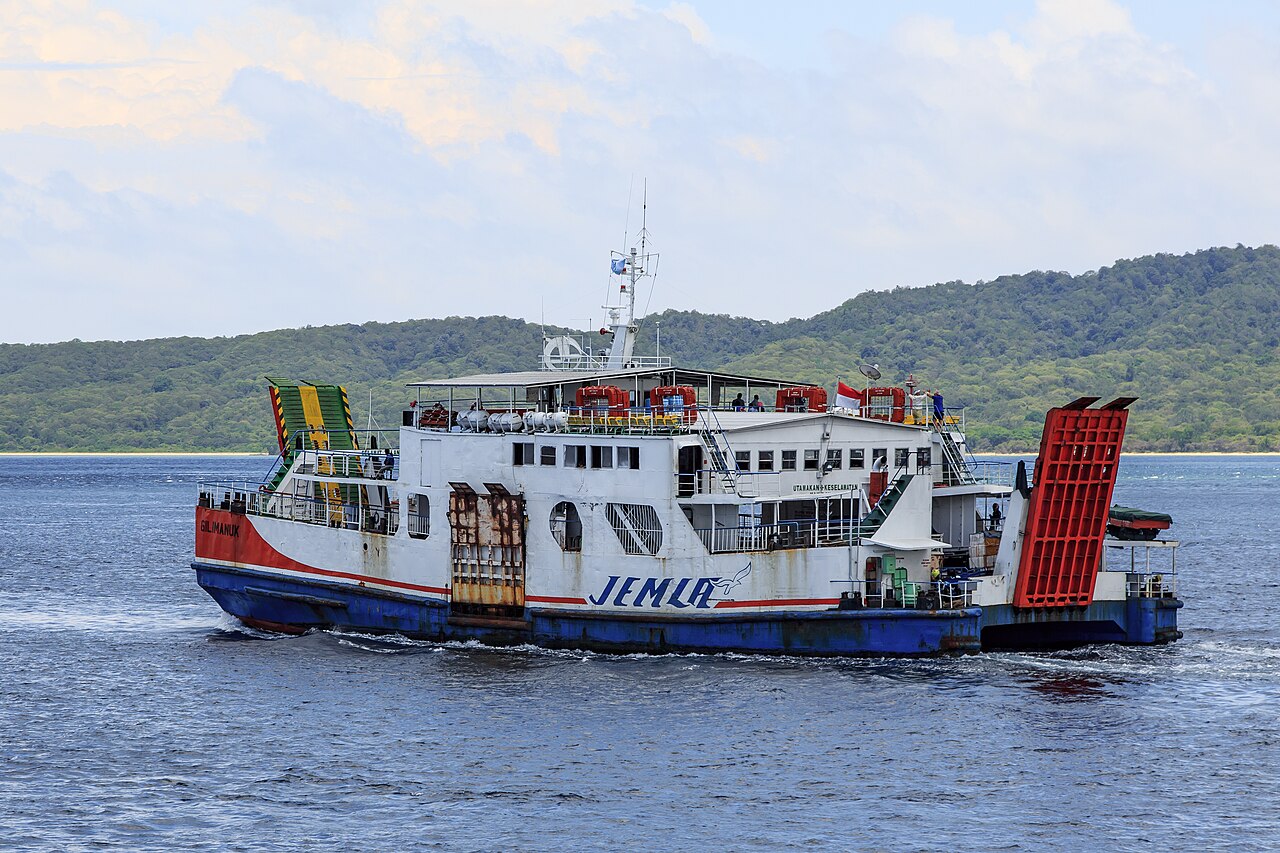
Top image: Photo: CEphoto, Uwe Aranas, CC BY-SA 3.0, via Wikimedia Commons

Electric vehicles are not banned from Indonesia’s ferries, but a growing number of owners and manufacturers are finding them turned away at the ramp. This week the dispute reached the national stage, with the EV industry complaining about refusals, ferry operators defending their caution and the Ministry of Transportation (Kemenhub) restating the safety rules that already allow EVs on board.
Industry complains of refusals
The issue was pushed into the spotlight by Moeldoko, chairman of the EV industry association Periklindo, who said industry players had been rejected by ship operators when trying to move electric motorbikes, trucks and passenger cars by sea, OtoDream reported. He called for standard safety procedures, pointing out that lithium-ion battery fires cannot be tackled with conventional firefighting methods. The report noted that large makers such as BYD can use their own car-carrier ships, while smaller brands depend on scheduled ferries and cargo services.
What the ministry says
Kemenhub’s position is that there is no prohibition. Samsuddin, the ministry’s director of shipping and maritime affairs, acknowledged that some operators were still reluctant to carry EVs, but said this was because certain safety conditions were not being met, according to OtoDream. The rules sit in circular SE-DJPL 12/2024, issued on 4 April 2024, which the ministry has now reissued to clear up misunderstandings between operators and passengers.
Under the circular, as summarised in that report:
- the battery should be charged to no more than 50%;
- EVs should be parked on an open deck, not on enclosed lower car decks;
- the ship needs open space to deal with an emergency; and
- operators must carry fire-fighting equipment suited to EV battery fires.
Operators: safety first, and deck space costs money
Ferry operators’ association GAPASDAP says it wants to carry EVs but will not compromise on safety. Its chairman, Khoiri Soetomo, cited the risk of thermal runaway, in which a battery overheats, resists extinguishing and can reignite, and said many ro-ro ferries lack fire blankets, trained crews and suitable space in their closed car decks, detikJatim reported. GAPASDAP wants Kemenhub and the classification society BKI to set technical standards for where EVs go on board, early-detection procedures, battery manifests and a clear split of responsibility between carmakers, ports and shipping firms.
On the busy Ketapang–Gilimanuk crossing between Java and Bali, state ferry company ASDP said it cannot refuse EVs without a legal basis. “We follow the policy from the centre,” said Media Syahrianto Heriawan, general manager of ASDP’s Ketapang branch (translated from Indonesian), in a separate detikJatim report. That report described the conditions as a 30–50% battery charge and parking on an open weather deck or a well-ventilated area near the ramp doors, covering battery-electric cars, hybrids, plug-in hybrids and fuel-cell vehicles. It also cited a second circular, SE-DRJD 7/2024. The ministry’s own summary gives only a 50% ceiling, so drivers should check the exact requirement with their operator.
The harbour authority for Tanjung Wangi, headed by Capt. Purgana, flagged a practical snag: reserving open-deck space for EVs that may or may not turn up leaves lanes empty, which costs operators revenue.
What it means for buyers
For anyone planning to drive an EV between islands, such as Java to Bali, Sumatra or Lombok, the rules make the trip possible but not guaranteed. Our reading of the reports suggests sensible steps: check with the operator before travelling, arrive with the battery at or below half charge (which may mean planning a charging stop after the crossing, see our charging guide), and expect to be directed to the open deck or asked to wait for a ship that has space. Plug-in hybrid and hybrid owners should note that the rules reportedly cover them too.
The bigger question is for the industry. If smaller brands struggle to ship vehicles and parts off Java, buyers in other regions could see slower deliveries and thinner after-sales support. A clearer national standard, as both Periklindo and GAPASDAP are requesting, would help. Browse which brands sell where in our EV directory.
Sources: OtoDream: Moeldoko on ferry refusals (23 Sep 2026); detikJatim: GAPASDAP explanation (24 Sep 2026); OtoDream: Kemenhub responds (25 Sep 2026); detikJatim: ASDP and KSOP Banyuwangi (25 Sep 2026)