
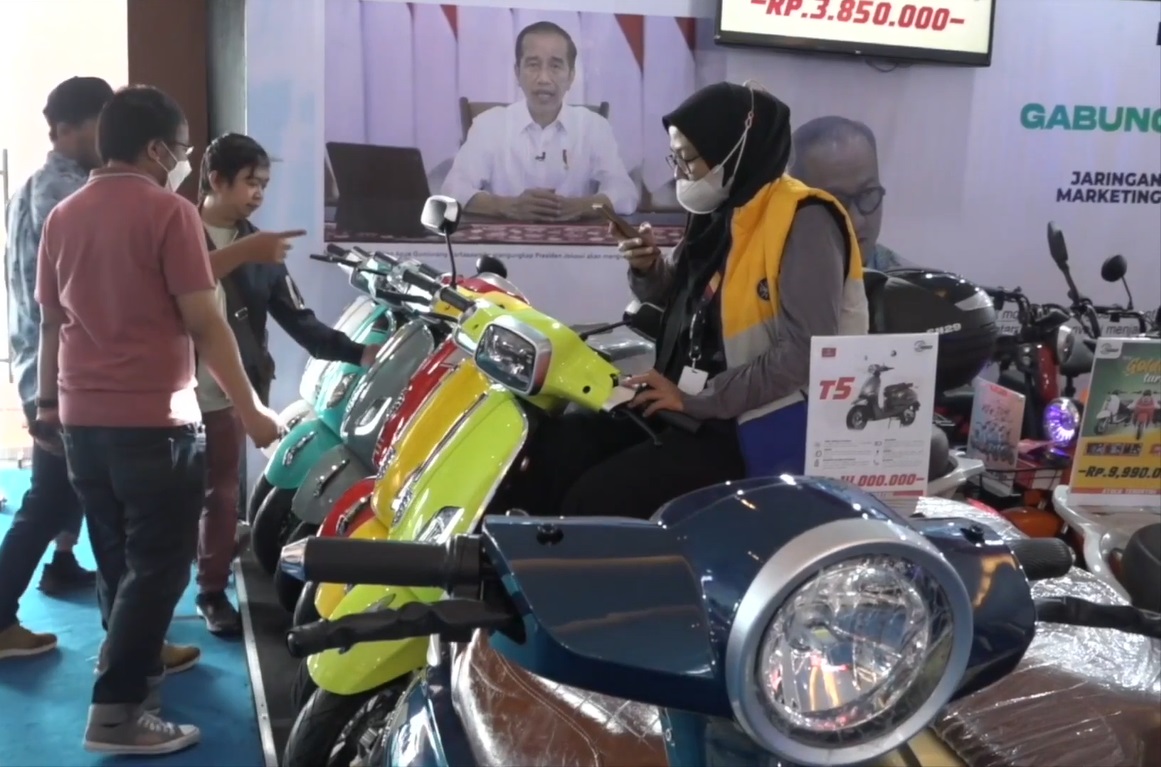
Top image: Photo: AntaraTV, CC BY 3.0, via Wikimedia Commons

Indonesian electric-motorbike maker ALVA has told members of parliament that building a local supply chain, not factory capacity, is the main obstacle to raising the share of domestic parts in its scooters. The message comes as the government’s local-content (TKDN) requirements for EVs are set to climb in stages towards 80%.
Parliamentary visit to Bekasi
A working committee (Panja) of the House of Representatives’ Commission VII, which is preparing a bill on industrial estates, visited the plant of PT Ilectra Motor Group, ALVA’s maker, in the Lippo industrial zone in Bekasi on 25 September, Suara reported. Chief executive Purbaja Pantja told the delegation that developing the EV industry is about building a supporting ecosystem as much as production capacity.
The company presented these figures, according to the report:
- annual production capacity of 100,000 units;
- local content above 40% across all its products, with frames, body panels and braking systems sourced locally, plus battery boxes and brackets from two state-backed small and medium-sized suppliers;
- more than 590 “Boost Charge” fast-charging connectors nationwide, up from about 150 previously; and
- 19 sales points, 10 experience centres and over 130 after-sales service locations.
Four problems with going more local
ALVA listed the obstacles to pushing localisation further: a small market, local suppliers that are not yet ready, the cost of investing in tooling, and the need for policy certainty. The first and last are linked. Electric-motorbike sales have slumped this year as buyers wait for a promised purchase incentive, as we reported earlier this week, and lower volumes make it harder to justify investing in local parts.
The TKDN staircase
According to a Jawa Pos report published the same day, the roadmap for EV local content sets a minimum of 40% in 2026, rising to 60% in 2027–2028 and 80% by 2030. Components maker Dharma Polimetal (DRMA) said it is ready to supply more locally made parts if the thresholds rise. “TKDN is very important, because it will help local industry grow and absorb workers,” director Darmawan Widjaja said (translated from Indonesian). He added that localisation pays off once volumes are large enough.
That last point echoes ALVA’s case to lawmakers: suppliers will commit to local production when they can see steady demand, and demand depends partly on incentives that themselves are usually tied to TKDN levels.
What it means for buyers
Local-content rules matter to buyers because government incentives for EVs are generally linked to them, so a brand that meets the threshold is better placed to offer a subsidised price when a scheme is running. More local parts should, over time, also mean easier access to spares and repairs. For now, ALVA’s figures suggest its range already clears the 40% bar. If you are comparing electric scooters, our electric motorbike buyer’s guide and the motorbike section of our EV directory list the main brands and prices.
Sources: Suara: ALVA outlines e-motorbike and TKDN challenges to DPR (25 Sep 2026); Jawa Pos: EV TKDN to rise in stages to 80%, DRMA ready (25 Sep 2026)