
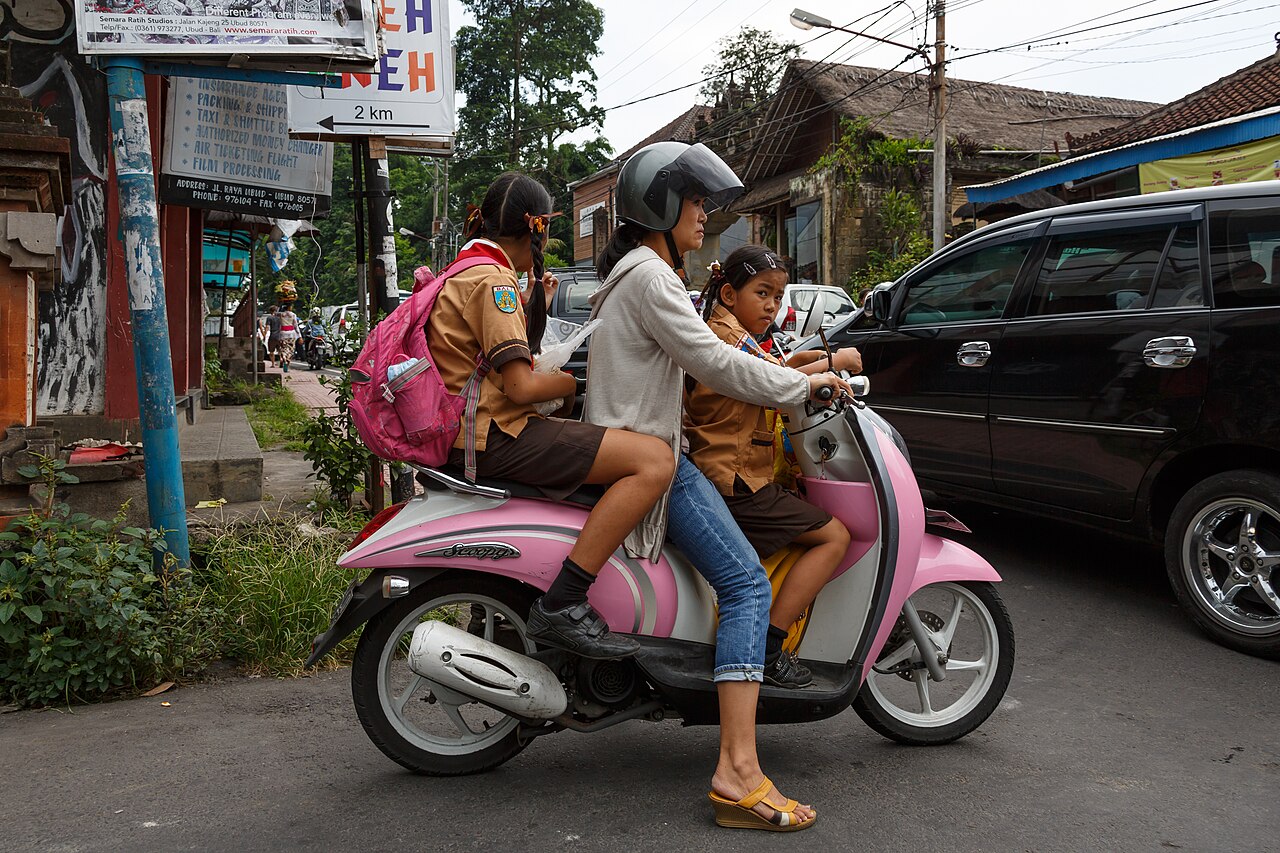
Top image: Photo: CEphoto, Uwe Aranas, CC BY-SA 4.0, via Wikimedia Commons

Bali has roughly doubled its electric vehicle fleet since the end of 2025. Provincial officials now say they want to start taxing EVs, once national rules allow it. They hope the central government’s zero-rate EV tax policy will be reviewed in 2027, according to a report in Bali Post on 16 November.
Fleet figures
Data as of 15 October cited by Bali Post put the island’s active vehicles at 3,566,533. Of these, 3,548,287 run on fossil fuels and 18,246 are battery-electric. The newspaper’s headline gives a slightly lower total of 18,034, and the article does not explain the difference.
The breakdown is more than 6,700 electric cars and around 11,000 electric motorbikes, which together make up about 17,700 of the total. That is roughly the figure we reported in October. The report puts growth since the end of 2025 at about 100%, but gives no exact 2025 baseline.
On our own calculation, battery-electric vehicles are still only about 0.5% of Bali’s active fleet.
For charging, the report says PLN’s Bali distribution unit (UID Bali) has recorded 315 public charging stations (SPKLU) at 215 locations. The count covers PLN’s own sites, partner sites and private sites. PLN UID Bali general manager Ajrun Karim said the network would be extended towards the north and east of the island.
A shift on EV tax
Under the central government’s 2026 incentive policy, the regional vehicle tax rate for battery EVs is zero. Bali’s revenue agency says this costs the province potential income from the annual vehicle tax (PKB) and the transfer fee (BBNKB). Agency head I Dewa Tagel Wirasa said EVs already fall within the scope of PKB under existing law. He said he hoped that by 2027 there would no longer be a central directive requiring the exemption, so regions could apply a consistent policy nationally.
Bali Post reported that the size of any future incentive still awaits direction from the central government. It named options of 25%, 50% or 75% as possible schemes for discussion. The idea is that EVs would keep some tax relief while regions earn some revenue. The report does not attribute these figures to a named official or say exactly which levy they would apply to. Bali also plans to watch how Jakarta, West Java and East Java handle EV tax, to avoid owners registering their cars in whichever province charges least.
The report noted that Bali’s clean-energy and battery-EV regulations (Governor’s Regulations 45/2019 and 48/2019) remain the basis of its EV policy. I Kadek Mudarta, head of the provincial transport agency, put it this way:
“Electric vehicles must be seen as a large ecosystem that requires collaboration from all parties.” — I Kadek Mudarta, to Bali Post (translated from Indonesian)
What it means for buyers
Nothing changes yet. EVs registered in Bali still benefit from the national zero-rate policy, and any new regional tax would need the central government to change its stance first. But Bali’s comments show that regional governments want some EV tax revenue. Buyers planning to keep a car for several years should factor in the chance of paying part of the normal vehicle tax from 2027. For how EV taxes currently work, see our EV tax incentives guide. For charging options, see our charging guide. If you are thinking of buying second-hand, see our new used EV buying guide.
Sources: Bali Post, “Meningkat 100 Persen dari 2025, Kendaraan Listrik di Bali Capai 18.034 Unit” (16 Nov 2026); IndoEVs (October 2026).
Comments
One response to “Bali EV fleet doubles as province eyes EV tax revenue from 2027”
[…] Update (17 November 2026): Bali now counts more than 18,000 battery EVs and 315 public chargers, and the province hopes to collect some EV tax from 2027. Read our follow-up: Bali EV fleet doubles as province eyes EV tax revenue from 2027. […]