
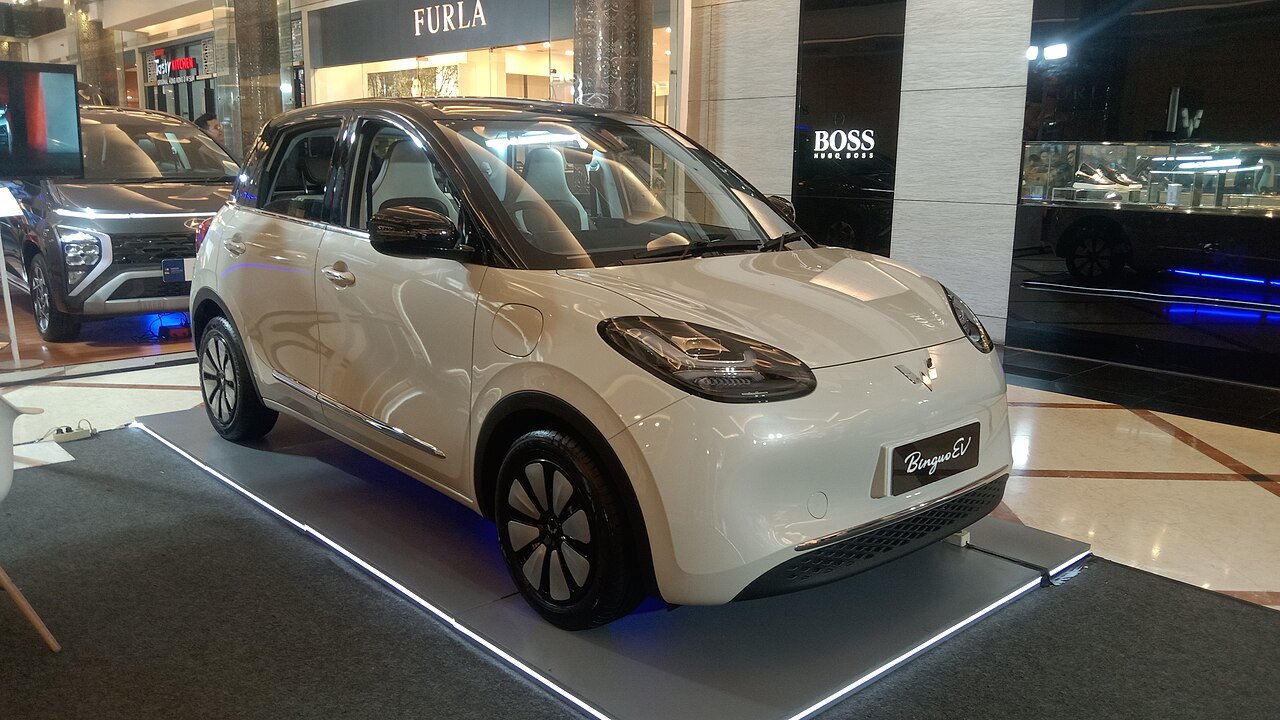
Top image: Wuling BinguoEV in Bandung. Photo: Mocarey15, CC0, via Wikimedia Commons

Wuling Motors says five of its Indonesian-built electric cars now meet a 60% local content (TKDN) rating, putting the brand ahead of the government’s plan to make 60% the bar for EV incentives from 2027. The announcement came in the same week that economists at the Institute for Development of Economics and Finance (INDEF) questioned whether the higher threshold will build a real supplier industry or simply become a paperwork exercise.
Which Wuling models qualify
According to Kompas.com, the five models are the New BinguoEV hatchback, the larger New Cloud EV, the Darion EV MPV, the Eksion EV SUV and the compact Aira ev city car. Wuling said the rating had risen from 40% to 60%, largely because it now assembles battery packs in Indonesia, sourcing pack packaging, battery housings and wiring harnesses locally.
The cars are built at Wuling’s plant in Cikarang, West Java, which handles body welding, painting, final assembly and quality checks. Local suppliers named by the company include PT Asahimas Flat Glass, tyre maker PT Gajah Tunggal and PT GS Battery. Vice President Arif Pramadana said the milestone would push Wuling to keep developing local production, including battery pack assembly.
Wuling joins a growing list of brands positioning for the new rule. Hyundai said this week that its Indonesian-built Neira seven-seater will clear 60%, while BYD has said its Subang-built cars already exceed 40% and target 60% for 2027.
INDEF: percentages are not enough
INDEF economist M Rizal Taufikurahman argued in a statement reported by Bisnis.com that the success of the policy should not be judged by the local-content percentage alone, but by whether it delivers domestic value added, technology transfer and stronger component suppliers.
“If the increase relies on assembly and bodywork while strategic components remain imported, industrial deepening will be limited,” Rizal said (translated from Indonesian).
He also warned that raising TKDN without demand certainty and ready suppliers could push up production costs and slow EV adoption, and that without strict oversight the rule risks becoming administrative compliance with limited industrial benefit. Local suppliers, he said, need financing for machinery, certification and quality support.
The legacy of the import window
Rizal’s wider point is about timing. Under the 2024–2025 incentive scheme, fully imported (CBU) EVs paid 0% import duty instead of the normal 50%, and 0% luxury sales tax (PPnBM) instead of 15%. In return, brands had to build the same number of cars locally, backed by bank guarantees, with that production due in 2026–2027 – the same period in which the 60% threshold arrives. The CBU window closed on 31 December 2025, but imported stock and the market share it built are still in play, so local producers face a stiffer climb.
The market itself is growing fast. Citing Gaikindo figures, INDEF noted battery EV wholesales reached 117,218 units in January–September 2026, about 17.26% of all car sales and already above the 103,931 sold in the whole of 2025 (see our January–September sales report). INDEF also flagged commercial vehicles: Indonesia imported 15,070 complete trucks from China in 2025, worth US$688.6 million, many with bodywork already fitted, leaving little work for local coachbuilders.
What it means for buyers
For now, little changes at the showroom. The 60% rule is due from 2027 (see our explainer on the new battery-pack requirement), and models that already meet it, such as the five Wuling EVs, look best placed to keep any VAT relief once it applies. Buyers considering a model that is still imported or below the threshold may want to ask dealers how the brand plans to qualify, as that could affect future pricing. Wuling’s full line-up is in our EV directory.
Sources: Kompas.com – Lima Mobil Listrik Wuling Sudah Kantongi TKDN 60 Persen (4 Nov 2026); Bisnis.com – INDEF Soroti Konsistensi Kebijakan Impor dan TKDN Kendaraan Listrik (6 Nov 2026)