
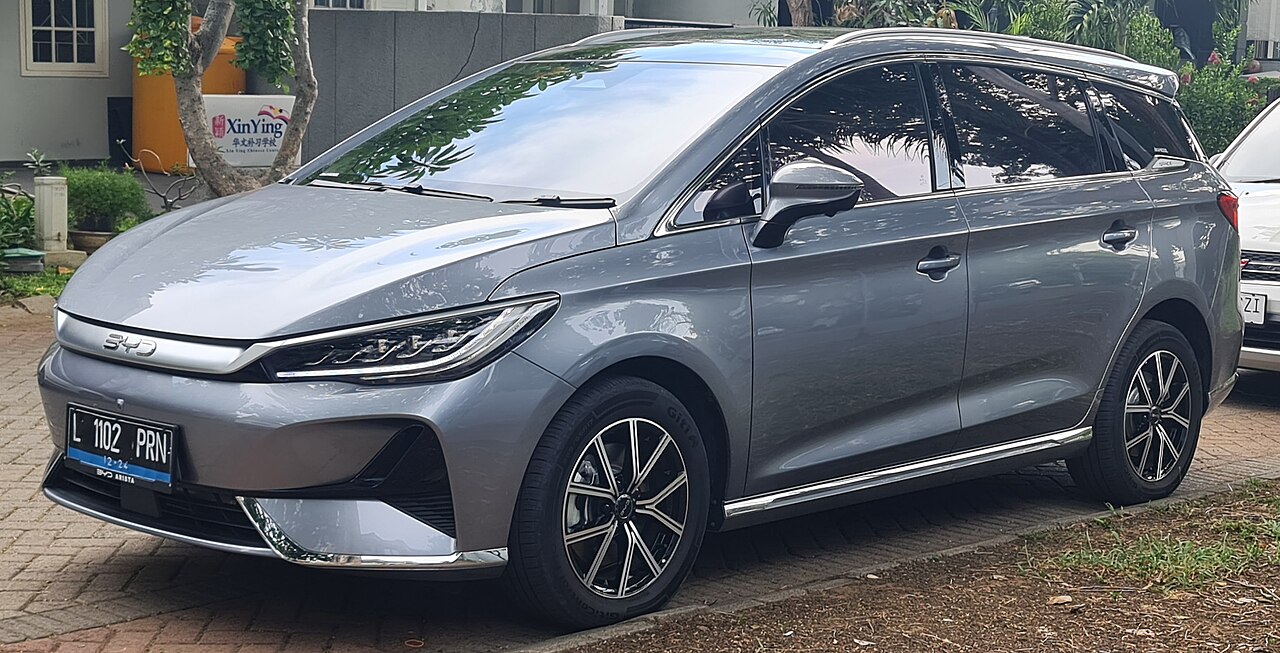
Top image: Photo: Alex Neman, CC BY-SA 4.0, via Wikimedia Commons. Pictured: a BYD M6 in Surabaya; the M6 is one of three BYD models now built at the Subang plant.

BYD Motor Indonesia says the cars rolling out of its new factory in Subang, West Java, already exceed 40% local content, and that it is confident of clearing the higher 60% threshold that Indonesia’s electric-vehicle rules set from 2027.
The comments, made by Luther Panjaitan, BYD Indonesia’s head of public relations and government relations, at a press event in South Jakarta and reported by Suara.com on 19 October, are the clearest signal yet that the market’s best-selling EV brand intends to keep its models eligible for incentives once the local-content bar rises.
What BYD said
According to Suara.com and an earlier interview with KatadataOTO, Panjaitan said:
- Units produced at BYD’s own Indonesian facility already have local content (TKDN) of more than 40%.
- Three models are now made locally: the Atto 1 city car, the M6 EV and the M6 DM plug-in hybrid. BYD said localising these models was a response to demand and would speed up deliveries to dealers.
- Because the Subang plant has its own stamping, welding, painting and assembly lines, the company says it has the flexibility to raise local content further.
Panjaitan argued that owning a factory is currently one of the most realistic ways for a carmaker to reach 60%. “We are very confident and will meet the government’s request to reach that target as soon as possible,” he said (translated from Indonesian, via Suara.com).
KatadataOTO also reported that one model from BYD’s premium Danza line-up will be assembled at a BYD facility in future, although no timing was given.
The Subang plant
The factory, in the Subang Smartpolitan industrial park, was inaugurated on 3 September. At the opening, BYD Indonesia president director Eagle Zhao said it can build up to 150,000 vehicles a year, that more than 5,000 local workers had already joined the company with a target of around 20,000, and that BYD was aiming to reach 60% TKDN from January 2027, Republika reported. Zhao also said BYD planned to carry out some battery-related assembly work in Indonesia, but gave no details of capacity or timing.
What the rules require
Local-content requirements for battery EVs are set by Presidential Regulation 79 of 2023. As summarised by KatadataOTO, the minimum is 40% for 2022–2026, rising to 60% for 2027–2029 and 80% from 2030. (Suara.com’s report describes the 60% stage as covering 2027–2028; we have followed the regulation’s dates as reported by KatadataOTO.)
BYD is not the only route to compliance. As we reported last week, the Ministry of Industry says brands could also reach 60% by using batteries from Indonesian producers, without needing to build their own plants. The ministry has also reaffirmed that the 60% rule will start in 2027.
Why it matters
BYD’s locally built Atto 1 topped EV wholesales in September with 4,840 units, ahead of the Jaecoo J5 EV (3,276) and Geely EX2 (1,890), according to Gaikindo figures cited by KatadataOTO. Keeping that model compliant is therefore important both for BYD’s volumes and for the wider market (see our January–September EV sales round-up).
What it means for buyers
For now, nothing changes at the showroom: the Atto 1, M6 EV and M6 DM are already built in Subang. The bigger question is 2027. Models that cannot show 60% local content may lose access to tax incentives, which could push up prices, while brands with Indonesian plants, or access to Indonesian-made batteries, should be better placed to hold prices steady. Buyers weighing an imported EV against a locally built one may want to ask dealers how each model will be treated after January 2027. Current BYD prices and models are listed in our EV directory entry for BYD.
Sources: Suara.com (19 Oct 2026); KatadataOTO (16 Oct 2026); Republika (3 Sep 2026).
Comments
One response to “BYD says Subang-built EVs already top 40% local content, eyes 60% for 2027”
[…] and Rp 618 million on the road in Jakarta, and are assembled by PT National Assemblers. BYD has set out a similar 60% target for its Subang […]