
Tag: Subang

  • BYD says Subang-built EVs already top 40% local content, eyes 60% for 2027

    BYD says Subang-built EVs already top 40% local content, eyes 60% for 2027

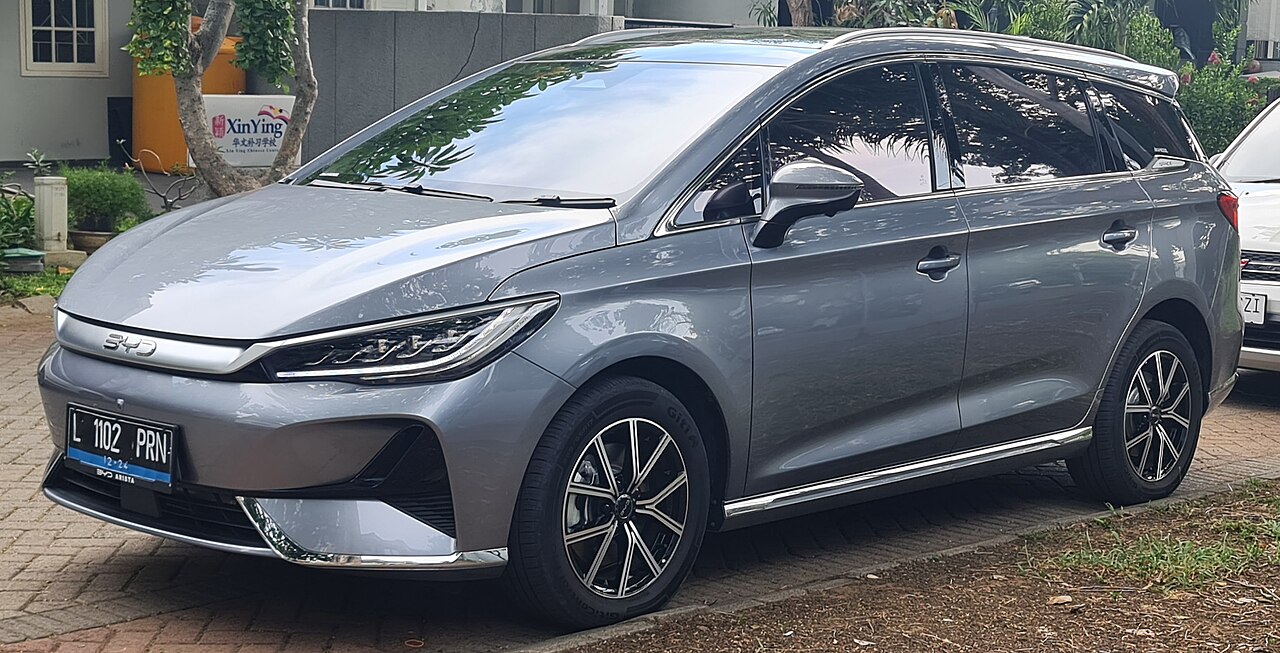
    Top image: Photo: Alex Neman, CC BY-SA 4.0, via Wikimedia Commons. Pictured: a BYD M6 in Surabaya; the M6 is one of three BYD models now built at the Subang plant.

    BYD Motor Indonesia says the cars rolling out of its new factory in Subang, West Java, already exceed 40% local content, and that it is confident of clearing the higher 60% threshold that Indonesia’s electric-vehicle rules set from 2027.

    The comments, made by Luther Panjaitan, BYD Indonesia’s head of public relations and government relations, at a press event in South Jakarta and reported by Suara.com on 19 October, are the clearest signal yet that the market’s best-selling EV brand intends to keep its models eligible for incentives once the local-content bar rises.

    What BYD said

    According to Suara.com and an earlier interview with KatadataOTO, Panjaitan said:

    • Units produced at BYD’s own Indonesian facility already have local content (TKDN) of more than 40%.
    • Three models are now made locally: the Atto 1 city car, the M6 EV and the M6 DM plug-in hybrid. BYD said localising these models was a response to demand and would speed up deliveries to dealers.
    • Because the Subang plant has its own stamping, welding, painting and assembly lines, the company says it has the flexibility to raise local content further.

    Panjaitan argued that owning a factory is currently one of the most realistic ways for a carmaker to reach 60%. “We are very confident and will meet the government’s request to reach that target as soon as possible,” he said (translated from Indonesian, via Suara.com).

    KatadataOTO also reported that one model from BYD’s premium Danza line-up will be assembled at a BYD facility in future, although no timing was given.

    The Subang plant

    The factory, in the Subang Smartpolitan industrial park, was inaugurated on 3 September. At the opening, BYD Indonesia president director Eagle Zhao said it can build up to 150,000 vehicles a year, that more than 5,000 local workers had already joined the company with a target of around 20,000, and that BYD was aiming to reach 60% TKDN from January 2027, Republika reported. Zhao also said BYD planned to carry out some battery-related assembly work in Indonesia, but gave no details of capacity or timing.

    What the rules require

    Local-content requirements for battery EVs are set by Presidential Regulation 79 of 2023. As summarised by KatadataOTO, the minimum is 40% for 2022–2026, rising to 60% for 2027–2029 and 80% from 2030. (Suara.com’s report describes the 60% stage as covering 2027–2028; we have followed the regulation’s dates as reported by KatadataOTO.)

    BYD is not the only route to compliance. As we reported last week, the Ministry of Industry says brands could also reach 60% by using batteries from Indonesian producers, without needing to build their own plants. The ministry has also reaffirmed that the 60% rule will start in 2027.

    Why it matters

    BYD’s locally built Atto 1 topped EV wholesales in September with 4,840 units, ahead of the Jaecoo J5 EV (3,276) and Geely EX2 (1,890), according to Gaikindo figures cited by KatadataOTO. Keeping that model compliant is therefore important both for BYD’s volumes and for the wider market (see our January–September EV sales round-up).

    What it means for buyers

    For now, nothing changes at the showroom: the Atto 1, M6 EV and M6 DM are already built in Subang. The bigger question is 2027. Models that cannot show 60% local content may lose access to tax incentives, which could push up prices, while brands with Indonesian plants, or access to Indonesian-made batteries, should be better placed to hold prices steady. Buyers weighing an imported EV against a locally built one may want to ask dealers how each model will be treated after January 2027. Current BYD prices and models are listed in our EV directory entry for BYD.

    Update (3 November 2026): The National Economic Council has since said the 60% requirement will apply from 2027 together with locally assembled battery packs. Read our follow-up.

    Sources: Suara.com (19 Oct 2026); KatadataOTO (16 Oct 2026); Republika (3 Sep 2026).
  • BYD opens 150,000-unit Subang factory, eyes 60% local content by 2027

    BYD opens 150,000-unit Subang factory, eyes 60% local content by 2027

    Top image: Photo: Exynoss78739, CC BY 4.0, via Wikimedia Commons

    BYD has formally opened its first Indonesian car factory, a 126-hectare site in the Subang Smartpolitan industrial estate in West Java, marking the Chinese brand’s shift from importing cars to building them locally. The plant was inaugurated on Thursday 3 September 2026 and has an annual production capacity of 150,000 vehicles.

    Investment, jobs and first models

    CNN Indonesia reported the investment at Rp11.6 trillion. The facility covers the core stages of car manufacturing – stamping, welding, painting and final assembly – and currently employs around 5,000 local workers, a figure that could rise to more than 20,000 once the plant runs at full capacity. The first model off the line was the BYD M6 DM plug-in hybrid MPV, which CNN Indonesia said carries local content of more than 40%.

    According to Antara, the plant’s line-up also includes the Atto 1, the battery-electric M6 and models from BYD’s premium Denza brand (since renamed Danza in Indonesia). detikOto reported that the factory is already producing around 10,000 units a month.

    Local-content targets and batteries next

    The opening comes as Indonesia tightens its local-content rules for electric vehicles. As The Jakarta Post noted, the domestic component threshold (known as TKDN) stands at 40% this year, rises to 60% from January 2027 and is set to reach 80% by 2030. BYD Indonesia president director Eagle Zhao told Antara that the company would be ready for the higher bar:

    “In 2027, we will certainly be the first to stand in support of the TKDN requirement, which will become 60 per cent.” – Eagle Zhao, BYD Motor Indonesia, to Antara (translated from Indonesian)

    Mr Zhao said battery assembly would form the next phase of BYD’s Indonesian investment, arguing that a product cannot truly be called Indonesian-made without a comprehensive local production process. BYD has also sent hundreds of Indonesian technicians and engineers to its research and development centre in China, according to Antara. The Jakarta Post reported that Mr Zhao sees Subang as a potential regional export base as well as a supplier to the home market.

    Government message

    President Prabowo Subianto did not attend the ceremony. Industry Minister Agus Gumiwang Kartasasmita delivered a message on his behalf, telling the audience that the transition of the market towards green mobility and electric vehicles needed to move faster, detikOto reported. CNN Indonesia said the minister described the plant as a milestone in moving from simply dominating sales to strengthening domestic components within the EV ecosystem.

    BYD Co. vice-president Liu Xueliang called the opening important not only for the company but for the Indonesian government. detikOto noted that Indonesian EV sales reached 83,758 units in January–July 2026, up 88.6% year on year – a market in which BYD has become the leading brand.

    What it means for buyers

    Local assembly matters for Indonesian buyers in several ways. The tax exemptions that allowed brands to import fully built EVs ended in 2025, so producing locally is now the main route for manufacturers to keep prices competitive. A domestic plant should also mean shorter waiting times, easier access to parts and, eventually, locally assembled batteries. Buyers comparing BYD models should check which variants are built in Subang and what local-content level they carry, as this can affect eligibility for government incentives.

    Several other brands, including VinFast, are pursuing local production in Indonesia, and the BYD opening raises the stakes for competitors ahead of the 60% local-content deadline in January 2027.

    Related on IndoEVs

    Related: Parts makers say EV local-content rules leave little room for suppliers

    Sources: CNN Indonesia – Pabrik BYD senilai Rp11 triliun di Subang akhirnya diresmikan; Antara – Usai resmikan pabrik Subang, BYD siapkan perakitan baterai di RI; detikOto – Pesan Presiden Prabowo buat BYD yang baru resmikan pabrik di Subang; The Jakarta Post – EV push gains traction as factories expand