
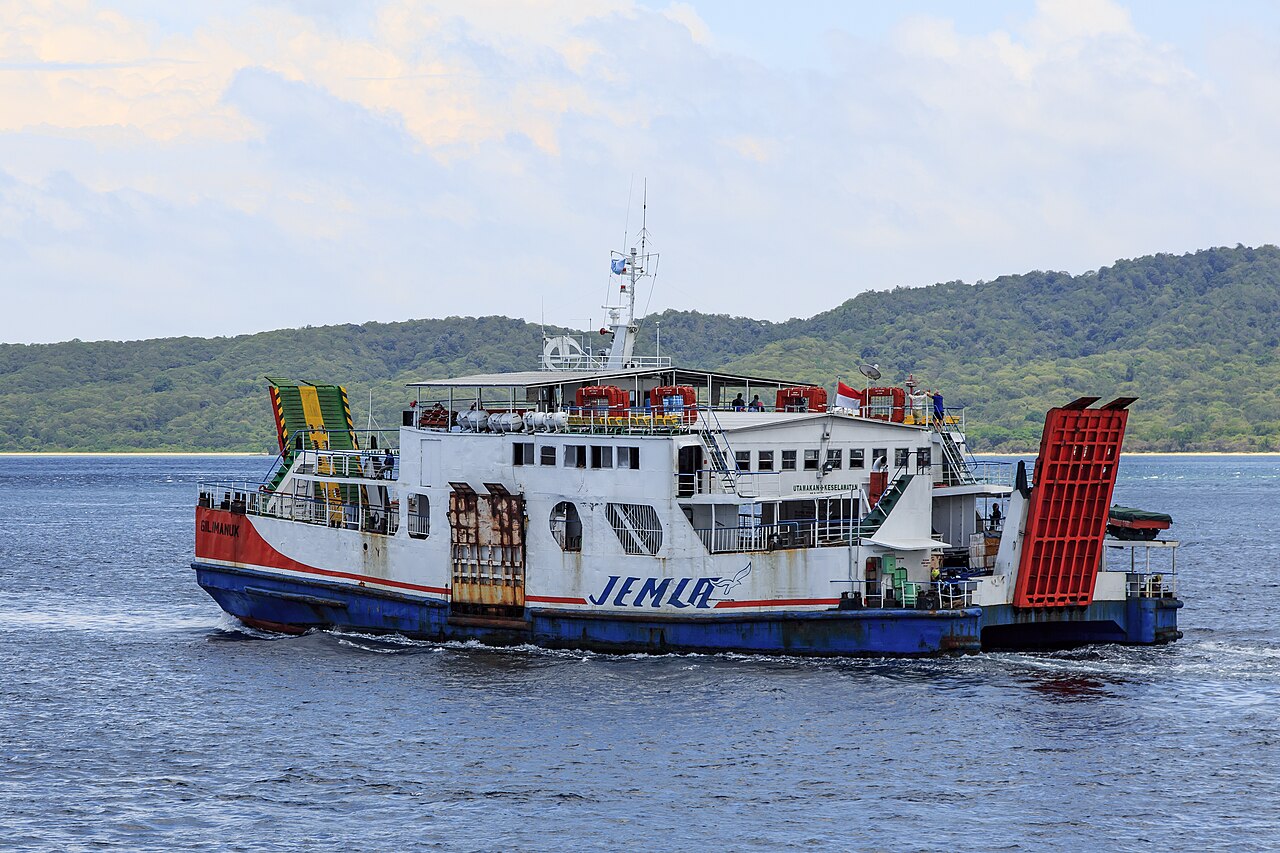
Top image: Photo: CEphoto, Uwe Aranas, CC BY-SA 3.0, via Wikimedia Commons

Indonesia’s Ministry of Transportation (Kemenhub) has opened the door to ships built or set aside specifically for carrying electric vehicles, a week after the EV industry complained that owners and manufacturers were being turned away from ferries. At the same time, the national ferry operators’ association has spelled out the conditions its members now apply when an EV rolls up to the ramp.
The comments were made on Friday 2 October at a press workshop in Bandung, West Java, and reported by CNBC Indonesia and CNN Indonesia. They follow the dispute we covered last week, when EV owners reported ferry refusals and the ministry restated its battery safety rules.
Ministry: EVs are allowed, and dedicated ships may follow
Lollan Andi Sutomo Panjaitan, acting director general of sea transportation at Kemenhub, repeated that electric vehicles may travel by sea as long as the safety conditions are met. On board, he said, they will be placed in designated areas that are watched more closely than the rest of the vehicle deck.
Looking further ahead, he floated the idea of separate tonnage for EVs. “Ideally, in time there could also be dedicated ships specifically for electric cars,” he said, according to CNBC Indonesia (translated from Indonesian). No timetable, budget or operator was attached to the idea, so for now it is an option rather than a plan.
What ferry operators now ask of EV owners
Khoiri Soetomo, chairman of Gapasdap, the association of river, lake and ferry operators, set out the procedures its members are using, as reported by both outlets:
- Arrive early. EV drivers are asked to check in ahead of other traffic so the crew can choose where to park the vehicle.
- Ventilated placement. EVs go in areas with good air circulation and blowers, where they can be monitored during the crossing.
- Do not board fully charged. Soetomo said batteries should not be at 100%.
- A last-resort fire plan. Vehicles are positioned so that, if a battery fire cannot be brought under control, the car can be pushed into the sea.
CNBC Indonesia also reported that Gapasdap and the state classification society, Biro Klasifikasi Indonesia (BKI), are drawing up certification standards for vessels that carry EVs, reflecting the fact that lithium-ion battery fires behave differently from petrol fires and need different equipment.
Which battery limit applies?
There is a gap between the operators’ wording and the ministry’s written rule. The governing document is still Kemenhub circular SE-DJPL 12 of 2024, issued on 4 April 2024, which CNN Indonesia said covers hybrids, plug-in hybrids, battery EVs and hydrogen fuel-cell vehicles. In September, CNBC Indonesia reported that the ministry’s guidance caps the charge at 50% and requires EVs to be parked on an open deck. “Not 100%”, as quoted from Gapasdap this week, is a looser description. Until the two are aligned, owners are safest working to the stricter 50% figure.
Why the industry pushed
The issue was escalated by Moeldoko, chairman of the EV industry association Periklindo, who told parliament’s Commission VII on 21 September that refusals were holding back distribution of electric motorbikes, cars and trucks between islands, CNBC Indonesia reported. Large brands such as BYD can operate their own car carriers, he noted, but smaller assemblers and dealers depend on scheduled ferries and cargo services. Separate EV vessels would ease that bottleneck, but would also add a new layer of cost and scheduling that the sector has not yet had to price in.
What it means for buyers
If you plan to take an electric car or motorbike between Java, Sumatra, Bali or other islands, expect extra checks rather than a ban. Charge to no more than 50% before you leave, allow time to arrive early, and be ready to be directed to an open or specially ventilated part of the deck. Plan a charging stop near the arrival port: our guide to SPKLU and home charging explains how to find one. Buyers outside Java may also see longer delivery times from smaller brands while shipping arrangements settle down, so check with the dealer before paying a deposit. You can compare which brands sell in Indonesia in our EV directory.
Related: Revised traffic law to classify vehicles by power source and cover self-driving
Sources: CNBC Indonesia, 2 Oct 2026; CNN Indonesia, 3 Oct 2026; CNBC Indonesia, 11 Sept 2026; CNBC Indonesia, 21 Sept 2026.