
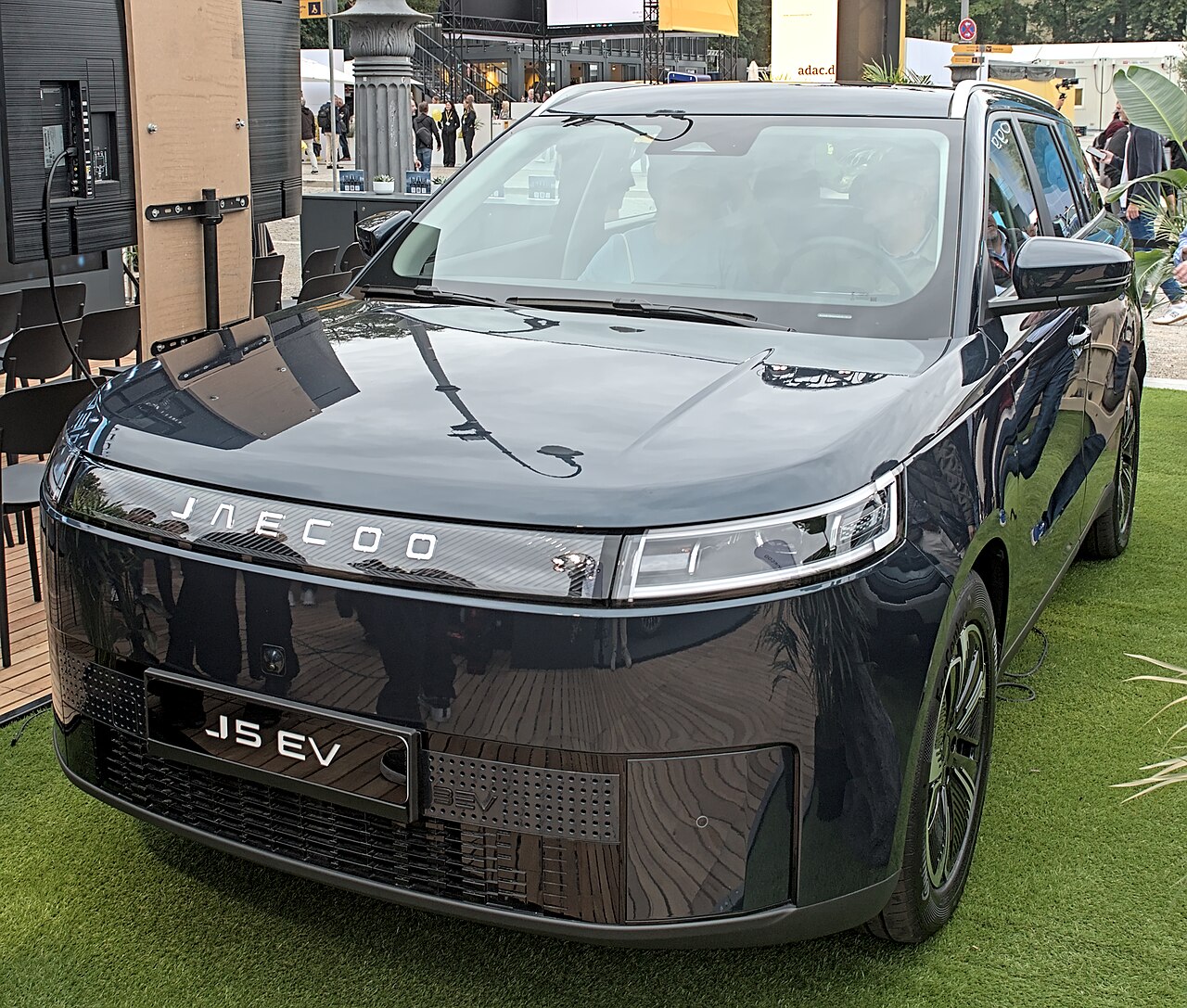
Top image: Photo: Alexander Migl, CC BY-SA 4.0, via Wikimedia Commons

Indonesia’s best-selling electric car has become a little more expensive again. Jaecoo has lifted the price of the top J5 EV Premium to Rp 324.9 million on the road in Jakarta, while the entry-level Standard stays at Rp 279.9 million. The company says currency movements, shipping and production costs are behind the change.
The adjustment was reported by kumparanOTO on 23 September, and followed up by Kompas and detikOto, which noted that no version of the J5 is now sold below Rp 250 million.
A step-by-step climb from the launch price
The J5 EV made its name with aggressive launch pricing of Rp 249.9 million for the Standard and Rp 299.9 million for the Premium. Since then the price has moved up in stages:
- April 2026: the Standard rose to Rp 279.9 million and the Premium to Rp 309.9 million, according to Moladin.
- Before this month’s change: kumparanOTO says the range last stood at Rp 279.9 million to Rp 319.9 million.
- Now: Rp 279.9 million (Standard) and Rp 324.9 million (Premium).
Headlines differ depending on the starting point. Kompas and detikOto compare today’s prices with the launch prices, giving increases of Rp 30 million for the Standard and Rp 25 million for the Premium. Compared with the previous list price, the latest move affects only the Premium and amounts to Rp 5 million. By our own calculation, the Standard is now 12% above its launch price and the Premium about 8% higher, and the gap between the two versions has widened to Rp 45 million.
The hardware has not changed. According to detikOto, the J5 EV still uses a 60.9 kWh battery with a claimed 461 km range on the NEDC cycle, a 155 kW motor and fast charging of up to 130 kW.
Why Jaecoo says prices went up
Jim Ma, business unit director at Jaecoo Indonesia, told Kompas that exchange rates, shipping costs and production costs had all fed into the decision. He said the company had options to keep prices flat but chose not to cut corners to do so:
“We will not sacrifice quality just to hold prices down.” – Jim Ma, Jaecoo Indonesia, to Kompas (translated from Indonesian)
He also told kumparanOTO that after-sales service and the customer experience would stay the same despite the higher price.
Demand is holding up so far
The price rise comes while the J5 EV is still selling strongly. kumparanOTO’s figures show monthly wholesales of between 1,942 units in January and 3,214 units in August 2026, averaging roughly 3,000 a month. The J5 was the best-selling battery electric vehicle in Indonesia over January to August, as we reported in our August sales round-up.
Jaecoo told kumparanOTO that buyers in Greater Jakarta (Jabodetabek) should wait no more than a month for delivery.
What it means for buyers
- The Standard is unchanged, for now. If you only need the base version, the price is the same as it has been since April. The Premium now costs Rp 45 million more.
- Prices are OTR Jakarta. On-the-road prices in other provinces can differ because of regional taxes, so check with your local dealer.
- Compare before you commit. At Rp 279.9 million to Rp 324.9 million, the J5 now sits in a busy mid-range bracket. Our electric car buying guide sets out the main rivals and their prices.
- Ask about dealer offers. A higher list price does not rule out discounts or financing deals, which vary by dealer and month.
Sources: kumparanOTO – Harga Jaecoo J5 Naik Lagi, Inden Paling Lama Satu Bulan (23 Sept 2026); Kompas – Harga Jaecoo J5 EV Naik, Ini Dalih Jaecoo Indonesia (25 Sept 2026); detikOto – Harga Jaecoo J5 Naik, Tak Ada Lagi yang di Bawah Rp 250 Juta (28 Sept 2026); Moladin – Update Penyesuaian Jaecoo J5 EV April 2026.
Comments
2 responses to “Jaecoo raises J5 EV Premium price again, citing currency and shipping costs”
[…] 789 million. Buyers should confirm the current price with a dealer, as several Chinese brands have raised EV prices this […]
[…] interpretation rather than a confirmed reason. We covered a similar move by Jaecoo last month in Jaecoo raises J5 EV prices, and our guide to EV tax incentives in 2026 explains which support schemes still […]