
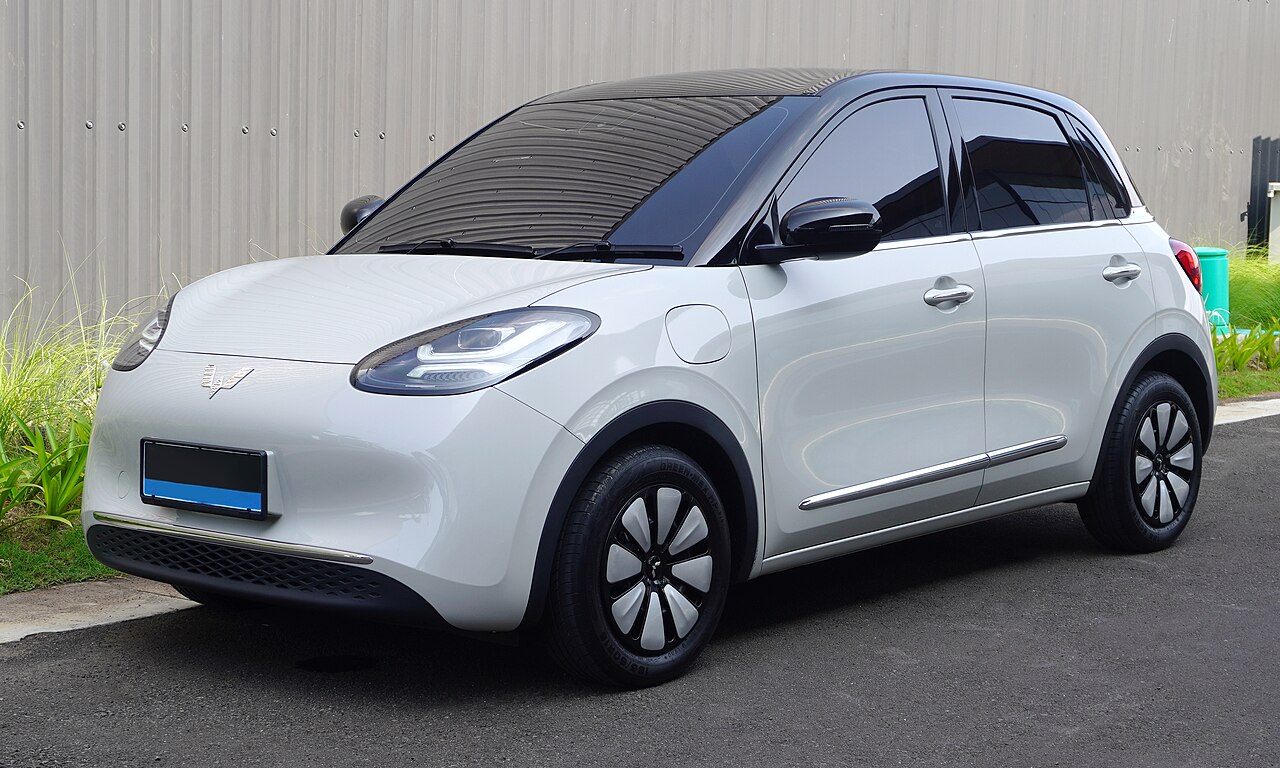
Top image: Photo: Andra Febrian, CC BY-SA 4.0, via Wikimedia Commons

Indonesia’s rule that locally built electric cars must reach 40% local content (TKDN) this year is doing less for domestic parts makers than the headline figure suggests, according to the country’s automotive component industry association.
Rachmat Basuki, secretary general of GIAMM (Gabungan Industri Alat Mobil dan Motor), told CNBC Indonesia on Monday 28 September that only a narrow range of EV parts is currently sourced from Indonesian suppliers. He listed tyres, wheel rims, safety glass, wiring harnesses and some interior parts as the main examples.
How the 40% is reached
The explanation lies in how the TKDN score for electric cars is weighted. As Rachmat described it to CNBC Indonesia, the calculation gives:
- 30% for carrying out vehicle assembly in Indonesia;
- 40% for localising the battery, down to cell level;
- 10% for localising other main or supporting components.
That means a manufacturer that assembles its cars locally already has three-quarters of the 2026 target in hand. In Rachmat’s words, the remaining gap is closed by localising a handful of components, “although not yet on a large scale” (translated from Indonesian).
For component makers, the practical effect is that a carmaker can clear the current bar without buying much from them. Rachmat said suppliers want a bigger role and noted that the government has twice organised business-matching sessions between parts makers and EV producers, on top of the contacts carmakers make on their own.
The bar rises from 2027
The pressure on the supply chain is set to grow. The Industry Ministry’s local-content path for EVs rises from 40% in 2026 to 60% for 2027–2029 and 80% from 2030, Antara reported earlier this month. Under the weighting described by GIAMM, those higher thresholds are hard to meet through assembly alone; they point towards local battery cells and a far deeper parts base. (This is our reading of the figures, not a statement by GIAMM.)
The government is also looking at tying future incentives more directly to local content. Speaking at the opening of BYD’s Subang plant on 3 September, Industry Minister Agus Gumiwang Kartasasmita said his ministry had been asked to study incentive schemes linked to TKDN and would work with the Finance Ministry on the design, according to Antara. He said the higher a product’s TKDN score, the more attention it should get from government. Antara reported on 26 September that this work on TKDN-based EV incentives is continuing.
We covered the BYD factory opening and its local-content plans at the time, and the parallel debate on the motorbike side, where ALVA told lawmakers local suppliers are the bottleneck as TKDN requirements climb.
Why batteries matter most
With battery localisation carrying the single largest weight in the formula, cell production is the lever that will decide whether carmakers can hit 60% and later 80%. That links the car market directly to Indonesia’s nickel and battery investment push, including the CATL–IBC plant in Karawang. Our guide to Indonesia’s EV and battery industry explains how those pieces fit together.
What it means for buyers
The 40% rule for 2026 is already in place, so nothing changes at the showroom as a result of these comments. The bigger question is 2027. If incentives are rewritten to reward higher TKDN scores, brands that have invested in local cells and parts could gain a price advantage, while those relying mainly on local assembly may have to absorb costs or raise prices. Buyers comparing models over the next year may find it worth asking dealers whether a car is locally assembled and what its TKDN rating is. Our electric car buying guide covers the current line-up and prices.
Update, 30 September: The Ministry of Industry has confirmed that the requirement will rise to 60% local content from 2027 and 80% from 2030. Read our follow-up.
Sources: CNBC Indonesia, 28 Sep 2026; Antara, 3 Sep 2026; Antara, 26 Sep 2026
Comments
One response to “Parts makers say EV local-content rules leave little room for suppliers”
[…] The comments came at a forum on Wednesday 30 September titled “Powering Indonesia Future: Green Cars, Blue Skies”, CNN Indonesia reported. They come two days after the parts makers’ association GIAMM warned that the current rules leave little room for local suppliers. […]