
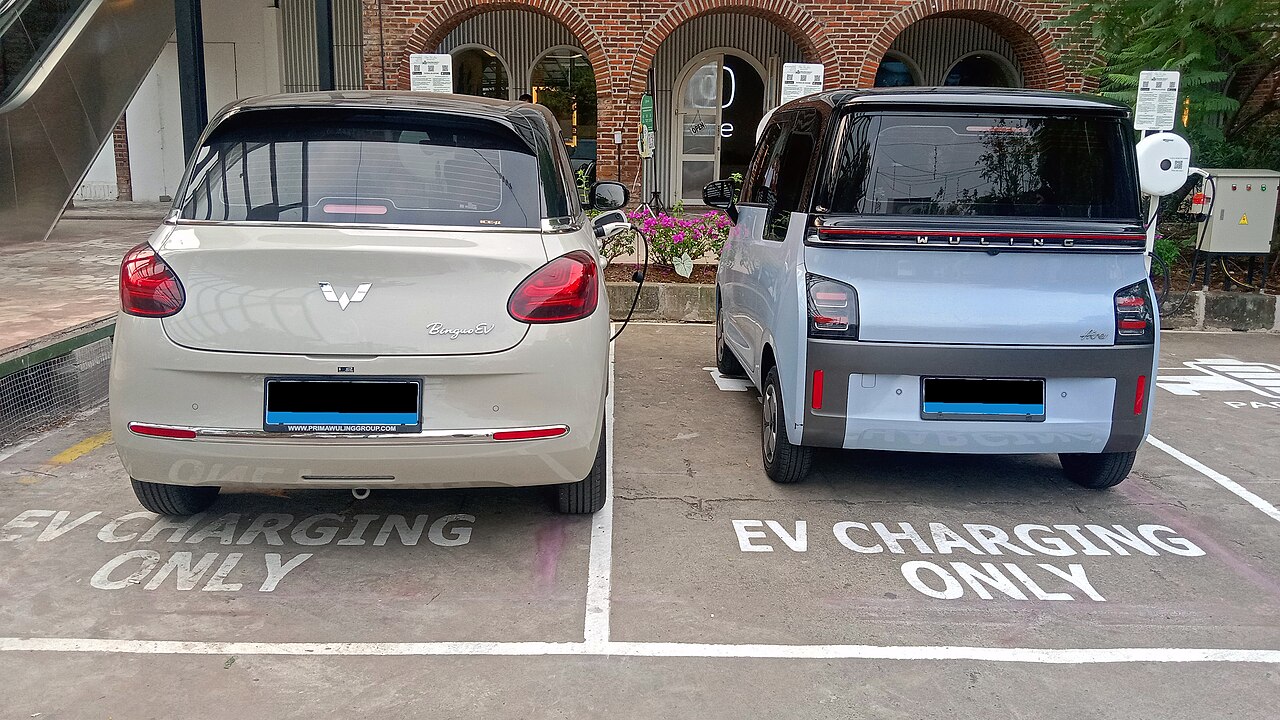
Top image: Photo: MoCars, CC0, via Wikimedia Commons

Purchase price gets most of the attention when Indonesians compare an electric car with a petrol one. Over several years of ownership, though, the running costs matter just as much. This guide sets out what electricity costs at home and at public SPKLU chargers in late 2026, how that compares with fuel at the pump, where the regional vehicle tax now stands, and which other costs and perks to factor in. All tariffs and prices below were current in mid-October 2026. Our own calculations are labelled as such.
Home charging: the cheapest option
Most EV owners do most of their charging at home, so the household electricity tariff is the number that matters most. The government left PLN’s non-subsidised tariffs unchanged for the October–December 2026 quarter. Energy and Mineral Resources Minister Bahlil Lahadalia confirmed on 5 October that prices would stay as they were, according to a summary of the tariff table. Earlier in the month he had hinted that a rise was unlikely, Bisnis.com reported.
The household rates per kWh this quarter are:
- 900 VA (non-subsidised, R-1): Rp1,352
- 1,300 VA and 2,200 VA (R-1): Rp1,444.70
- 3,500–5,500 VA (R-2) and 6,600 VA and above (R-3): Rp1,699.53
Most homes need at least 2,200 VA to run a car charger alongside everyday appliances, and many owners upgrade further. That can push them into the higher R-2 band, so it is worth checking where you will land before you increase your connection.
The PLN home-charging discount
Owners who sign up for PLN’s Home Charging Service (HCS) get a 30% discount on electricity used for charging between 22:00 and 05:00. In August, Investor Trust reported that PLN was offering HCS installation from Rp11.7 million under a promotion running until 31 December 2026, with electricity vouchers of up to Rp1.3 million. It also reported that home-charging customers had passed 92,000 by June.
Our calculation: with the 30% discount, a 2,200 VA household pays about Rp1,011 per kWh overnight, and an R-2 or R-3 household about Rp1,190.
Public charging at SPKLU
Public chargers cost more. Recent guides from Auto2000 and Navigasi put PLN’s SPKLU energy rate at roughly Rp2,466–2,475 per kWh. Fast chargers (about 25–50 kW) add a service fee of up to Rp25,000 per session, and ultra-fast chargers (above 50 kW) add up to Rp57,000.
Navigasi gives a worked example. Charging a 45 kWh battery from 10% to 80% (about 31.5 kWh) on a fast charger comes to around Rp114,000 once the session fee and 11% VAT are included. In practice, public fast charging costs well over twice as much per kWh as overnight charging at home. It makes sense for long trips, but it is an expensive way to cover your everyday driving. For details on finding chargers and connector types, see our guide to charging in Indonesia and the PLN SPKLU directory entry.
How this compares with petrol
Fuel prices did not change on 1 October. Pertamina’s prices stayed at Rp10,000 a litre for subsidised Pertalite, Rp15,950 for Pertamax (RON 92) and Rp19,600 for Pertamax Turbo, Katadata reported. BP 92 and Vivo Revvo 92 were listed at Rp16,130.
To compare like with like, we used two assumptions of our own. They are illustrative figures, not test results. The electric car uses 15 kWh per 100 km, which is typical of a compact EV in mixed driving. The petrol car averages 12 km per litre, which is typical of a small hatchback or MPV in city traffic. On those assumptions, our calculation of the energy cost per 100 km is:
- Home charging at 2,200 VA, with the HCS night discount: about Rp15,200
- Home charging at 2,200 VA, without the discount: about Rp21,700
- SPKLU energy only (Rp2,475/kWh, before any session fee or VAT): about Rp37,100
- Pertalite at Rp10,000/litre: about Rp83,300
- Pertamax at Rp15,950/litre: about Rp132,900
Over 15,000 km a year, the gap is large. On our assumptions, discounted home charging costs about Rp2.3 million a year, against roughly Rp12.5 million on Pertalite or Rp19.9 million on Pertamax. Your own figures will depend on your car, your driving and how much you use public chargers. Keep in mind too that access to subsidised Pertalite is restricted for many cars, so Pertamax is often the fairer comparison.
Regional vehicle tax: no longer automatically zero
For several years, battery EVs in most provinces paid little or no annual vehicle tax (PKB) and no transfer duty (BBNKB). That is changing. Home Affairs Minister Tito Karnavian signed Permendagri No. 11 of 2026 on 1 April. Under it, battery EVs are treated as ordinary motor vehicles and are no longer named as exempt, Tirto explained. Provinces can still grant relief, but it is no longer automatic.
Provinces are responding differently. West Java’s governor, Dedi Mulyadi, said in April that he wants EV tax to remain a source of regional revenue, Liputan6 reported. In Jakarta, Bapenda said in May that the PKB and BBNKB exemptions were unchanged for now, according to CNN Indonesia. In July, however, a special adviser to the governor, Firdaus Ali, described a scheme still under study. It would tax EVs on a sliding scale, from a possible exemption below Rp150 million up to 75% of the normal rate for luxury models, Suara reported. No final regulation had been named in that report.
The practical advice is to check your provincial Bapenda’s current rate before you buy, and to budget for some annual tax even if the first year is free. Our guide to EV taxes and incentives in 2026 covers the national VAT and luxury-tax side.
Other costs and perks
Servicing
An electric drivetrain has no engine oil, spark plugs, fuel filters or clutch, so routine servicing is usually simpler. Tyres, brakes, suspension, air-conditioning and the 12-volt battery still need attention. Before you sign, ask the dealer for the scheduled service prices and check the battery warranty terms, including the duration and any mileage cap.
Jakarta’s odd-even exemption
Battery EVs remain exempt from Jakarta’s odd-even (ganjil genap) number-plate restriction. Transport agency head Syafrin Liputo confirmed in May that the city would keep the policy, CNN Indonesia reported. For commuters on restricted roads, that can be worth as much as the fuel savings.
Insurance and resale
Insurance premiums are linked to the vehicle’s value, so a pricier EV will cost more to insure than a cheaper petrol rival. Resale values for many newer Chinese EV brands are still being established. Shop around for cover, and treat resale assumptions with caution.
What it means for buyers
If you can charge at home overnight, an EV’s energy bill is a fraction of what a petrol car costs to fuel. It stays far cheaper even against subsidised Pertalite. That advantage shrinks if you rely mainly on public fast chargers, and regional tax is becoming a cost to budget for rather than a perk to count on. Before you buy, check the tariff band your home will need, compare HCS installation offers, and confirm your province’s EV tax rate. You can compare models and prices in our electric car buying guide and the IndoEVs EV directory.
Sources: Journalarta (PLN tariffs, Oct 2026); Bisnis.com; Investor Trust; Auto2000; Navigasi; Katadata; Tirto; Liputan6; CNN Indonesia; Suara.com.