
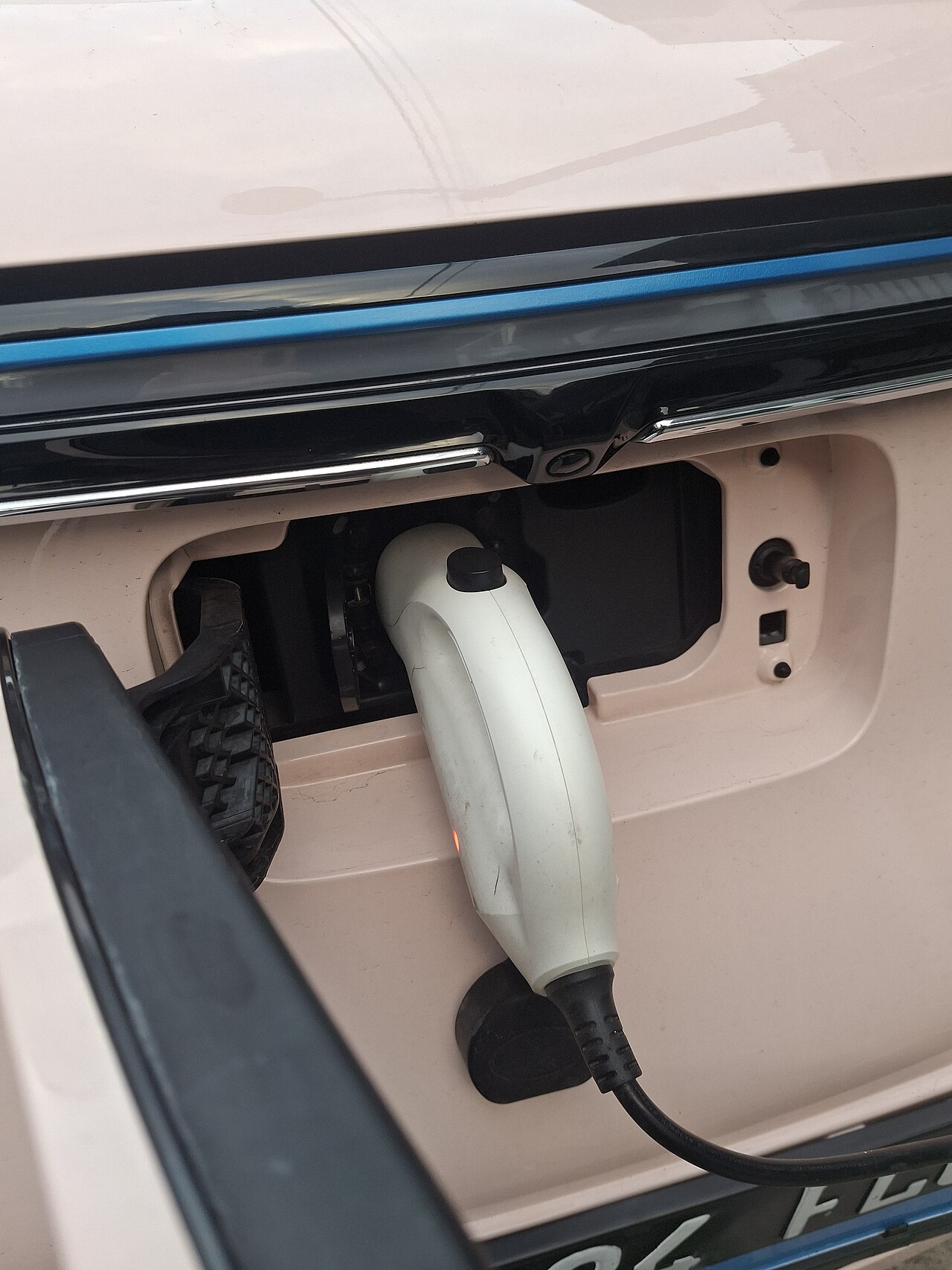
Top image: Photo: MRWikiTankenTai, CC0, via Wikimedia Commons

Most electric car owners in Indonesia do the bulk of their charging at home, overnight. Getting that set up properly is not just a question of buying a charger. You may need more power from PLN, a qualified installer and the right paperwork. This guide explains what is involved, what it typically costs and how to keep running costs down. For public charging and battery swapping, see our main charging guide.
Portable charger or wallbox?
There are two ways to charge at home.
- Portable charger: the cable that plugs into a regular socket. It is the slowest option (around 2.2 kW). Metro TV puts the household supply needed at 2,200–3,500 VA, with a full charge taking roughly 8–12 hours.
- AC wallbox: a fixed unit on a dedicated circuit, usually around 7 kW for single-phase homes. Metro TV says a wallbox typically needs 7,700–11,000 VA, and some models need more.
What your car can accept matters as much as the charger. The Wuling Air ev, for example, charges at 2.2 kW or 6.6 kW and can be charged from a 2,200 VA home connection, according to detikOto. The BYD Atto 1 accepts up to 6.6 kW on AC (paultan.org). A charger more powerful than the car’s onboard charger will not make charging faster.
Do you need more power (tambah daya)?
Many Indonesian homes are on 1,300 VA or 2,200 VA connections. A 7 kW wallbox running alongside air conditioning, a water pump and kitchen appliances will trip the breaker on these. BYD Indonesia, for instance, has said a home needs at least 7,700 VA to install its wallbox for the Atto 1 (detikOto).
Upgrading is done through PLN. The normal fees published for 2026 include, according to Metro TV’s tariff table:
- 2,200 VA to 3,500 VA: Rp1,259,700
- 2,200 VA to 5,500 VA: Rp3,197,000
- 3,500 VA to 5,500 VA: Rp1,938,000
- 450 VA to 7,700 VA: Rp7,025,250
Based on those figures (our calculation), the fee works out at about Rp969 for each extra VA when the new capacity is 3,500 VA or more. Going from 2,200 VA to 7,700 VA would therefore cost roughly Rp5.3 million at the normal rate.
PLN runs 50% discount campaigns on upgrades several times a year. The most recent one, from 22 October to 4 November 2026, halved the fee for single-phase customers moving up to 7,700 VA (Katadata). Conditions applied: no arrears, no phase change, and no reducing power again for a year. If you are not in a hurry, it can pay to wait for the next promotion.
Applications go through the PLN Mobile app, under the “Ubah Daya & Migrasi” menu. A PLN officer then contacts you to schedule the work (Metro TV).
A higher VA rating also moves you into a different tariff class. Homes on 3,500 VA and above pay Rp1,699.53 per kWh, compared with Rp1,444.70 at 1,300–2,200 VA (see below).
What a wallbox costs
Some brands have included a wallbox with the car, while others sell it separately, so check the deal before you sign. BYD sells the Atto 1 without a wall charger. The unit costs about Rp8.5 million, before any power upgrade (detikOto). Metro TV puts the general range for a wallbox plus installation at about Rp6 million to more than Rp15 million, excluding the PLN upgrade.
PLN also sells an all-in package through its Home Charging Services (HCS) Ultima programme. It is priced at roughly Rp12 million: Medcom reported “Rp12 jutaan”, while CNBC Indonesia said from Rp11.7 million. Medcom says the package includes:
- an SNI-compliant charger tested by PLN
- installation materials (cable, MCB, RCCB, earthing and ground rod)
- fitting by a certified partner and activation in PLN Mobile
- a power upgrade or new connection if one is needed
Demand is growing quickly. PLN added 21,865 home-charging customers in the first half of 2026, taking the total above 92,000, CNBC Indonesia reported.
Rules and safety
Home charging is covered by Energy and Mineral Resources Ministry Regulation No. 1 of 2023 on charging infrastructure (Permen ESDM 1/2023). It treats a home charger as a private electrical installation for your own use. That means you do not need a business licence, but you cannot resell electricity to others.
The regulation requires the installation to meet the requirements for a Sertifikat Laik Operasi (SLO), the certificate showing an electrical installation is fit to operate. Chargers must carry product certification where an SNI standard is mandatory. In practice:
- Use a certified installer, either the dealer’s, PLN’s or an accredited contractor.
- Put the charger on its own circuit with a correctly rated MCB and residual-current protection (RCCB).
- Make sure the house has proper earthing. Older homes often lack it.
- Keep the unit out of direct rain unless it is rated for outdoor use, and do not run a portable charger through extension leads.
Electricity tariffs and the night-time discount
PLN confirmed that household tariffs are unchanged for October–December 2026 (Kontan):
- R-1 1,300 VA and 2,200 VA: Rp1,444.70 per kWh
- R-2 3,500–5,500 VA and R-3 6,600 VA and above: Rp1,699.53 per kWh
PLN also offers EV owners on its home-charging programme a 30% discount for charging between 22:00 and 05:00. Medcom and CNBC Indonesia report that it is valid until 31 December 2026, so check PLN Mobile for the current terms before relying on it in 2027.
A worked example
Take a BYD Atto 1 Premium with a 38.88 kWh battery (paultan.org) on a 7,700 VA connection. The figures below are our own calculations and ignore charging losses, which typically add 10–15% in practice.
- A full charge from empty uses about 38.9 kWh, costing roughly Rp66,000 at the R-2/R-3 rate.
- With the 30% night discount, it costs roughly Rp46,000.
- On a 6.6 kW wallbox, charging takes a little under six hours, so it is comfortably done overnight.
Most drivers start from a partly charged battery, so a typical night’s top-up will cost less. Our running-costs guide compares these figures with petrol.
What it means for buyers
- Check your meter first. On 2,200 VA or less, a portable charger may be all you can use without an upgrade.
- Budget for the full cost. Allow for the charger, installation and a possible tambah daya when comparing an EV with a petrol car. The charger and installation alone typically cost Rp6–15 million or more, before any upgrade fee.
- Negotiate. Ask the dealer whether a wallbox or installation is included. These offers change often.
- Time it well. Watch for PLN’s 50% upgrade promotions, and set the car to charge after 22:00 if you are on the discount scheme.
Sources: Kontan (3 Nov 2026); Metro TV (14 Jun 2026); Metro TV (23 Oct 2026); Metro TV (13 Aug 2026); Katadata (24 Oct 2026); Medcom (2 Aug 2026); CNBC Indonesia (6 Aug 2026); detikOto (15 Aug 2025); detikOto (15 Jul 2022); paultan.org (24 Jul 2025); Permen ESDM 1/2023.
Comments
2 responses to “Installing a home EV charger in Indonesia: power upgrades, costs and tariffs”
[…] Related guide: Installing a home EV charger in Indonesia: power upgrades, costs and tariffs. […]
[…] Related guide: Installing a home EV charger in Indonesia: power upgrades, costs and tariffs. […]