
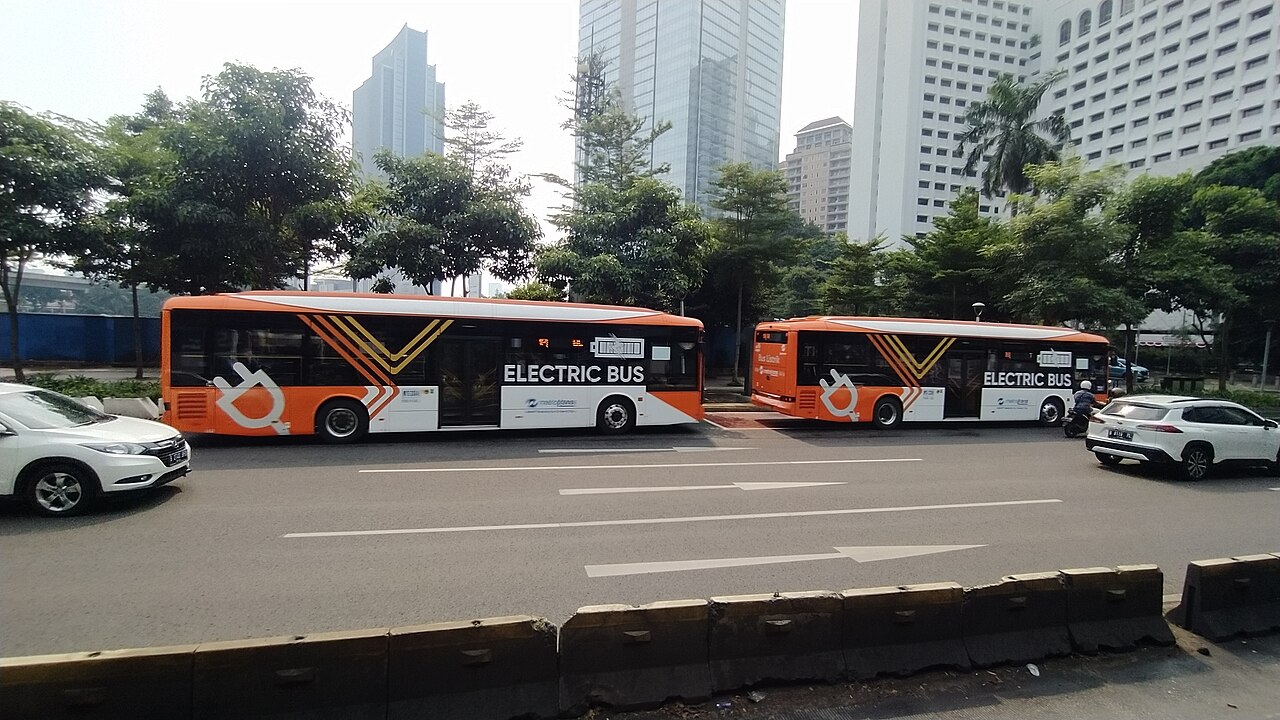
Top image: Photo: NFarras, CC BY-SA 4.0, via Wikimedia Commons

The Indonesian Electric Vehicle Industry Association (Periklindo) has asked the government to extend electric-vehicle incentives beyond passenger cars to commercial vehicles such as buses and logistics trucks, adding a new voice to a policy debate that has so far centred on private cars and, this week, hybrids.
Periklindo chairman Moeldoko made the case at a press conference in Jakarta on 22 October to promote the PEVS 2026 electric vehicle show, which runs from 29 October to 1 November at JIExpo Kemayoran. According to VIVA, he said the association has written to the government asking for commercial vehicles to be included in EV incentive policy.
Why commercial vehicles?
Moeldoko argued that commercial vehicles use a lot of fuel and emit a lot of CO2, and that Indonesia’s logistics costs are relatively high, so electrifying fleets could cut both emissions and operating costs for businesses that depend on distribution. Bus operators in particular face rising running costs as fuel prices climb, Investortrust reported, while JPNN said he also named logistics trucks as a target.
“So far only passenger vehicles have been considered; all incentives have focused on passenger cars.” – Moeldoko, as quoted by Investortrust (translated from Indonesian)
On the form of support, VIVA reported that Moeldoko suggested commercial vehicles could get the same kind of tax relief as passenger EVs, referring to a reduction from a 10 per cent rate, alongside non-fiscal perks in selected regions such as tourist areas. He gave no cost estimate, and the government has not announced any commercial EV incentive. Moeldoko also said that, in his view, EVs will need incentives until adoption reaches roughly 30 per cent; that is not an official target.
A crowded incentive debate
The call came a day after Industry Minister M. Sarmuji said he would ask the Finance Minister to consider incentives for hybrids, plug-in hybrids and range-extended EVs (REEVs), possibly including exemption from Jakarta’s odd-even traffic rule, as we reported earlier. CNBC Indonesia reported that Sarmuji hopes the incentives can take effect this year, or early next year if not.
Unlike economists at INDEF, who argued that incentives should stay focused on battery EVs, Moeldoko did not oppose the hybrid plan. CNBC Indonesia quoted him as saying hybrids still help cut fuel consumption and CO2, and that fiscal and non-fiscal incentives are a concrete way to speed up the take-up of cleaner vehicles.
The wider passenger-car package is still unclear. Bisnis.com reported on 23 October that, as of mid-October, the government had not officially announced the scheme or timetable for incentives covering 500,000 electric cars and 500,000 electric motorbikes that Finance Minister Purbaya Yudhi Sadewa had mentioned earlier. Separately, the local-content (TKDN) threshold linked to EV incentives is due to rise from 40 per cent to 60 per cent in 2027.
What it means for buyers
For private buyers, Periklindo’s push for commercial vehicles changes nothing immediately. The bigger question for anyone shopping for an EV now is whether the passenger-car incentives and the 2027 local-content rules will change which models qualify, and at what price. Bisnis.com’s own illustration shows the stakes: on a car priced at Rp 300 million before tax, 12 per cent VAT comes to Rp 36 million, so the size of any VAT relief makes a material difference. Until the rules are published, buyers should check whether a quoted price assumes an incentive that has not yet been confirmed. Our guide to EV taxes and incentives in 2026 explains the current position.
Fleet operators, from bus companies to delivery and ride-hailing firms, have more reason to watch closely. If commercial EVs gain tax relief, the economics of electric buses and vans, such as the locally assembled DFSK Gelora E, would improve, but there is no timetable yet. Expect the subject to come up again at PEVS next week, where VIVA lists exhibitors including BAIC, BYD, Chery, DFSK, MAB, MG, Polytron and Wuling.
Sources: VIVA; Investortrust; JPNN; CNBC Indonesia; Bisnis.com.