
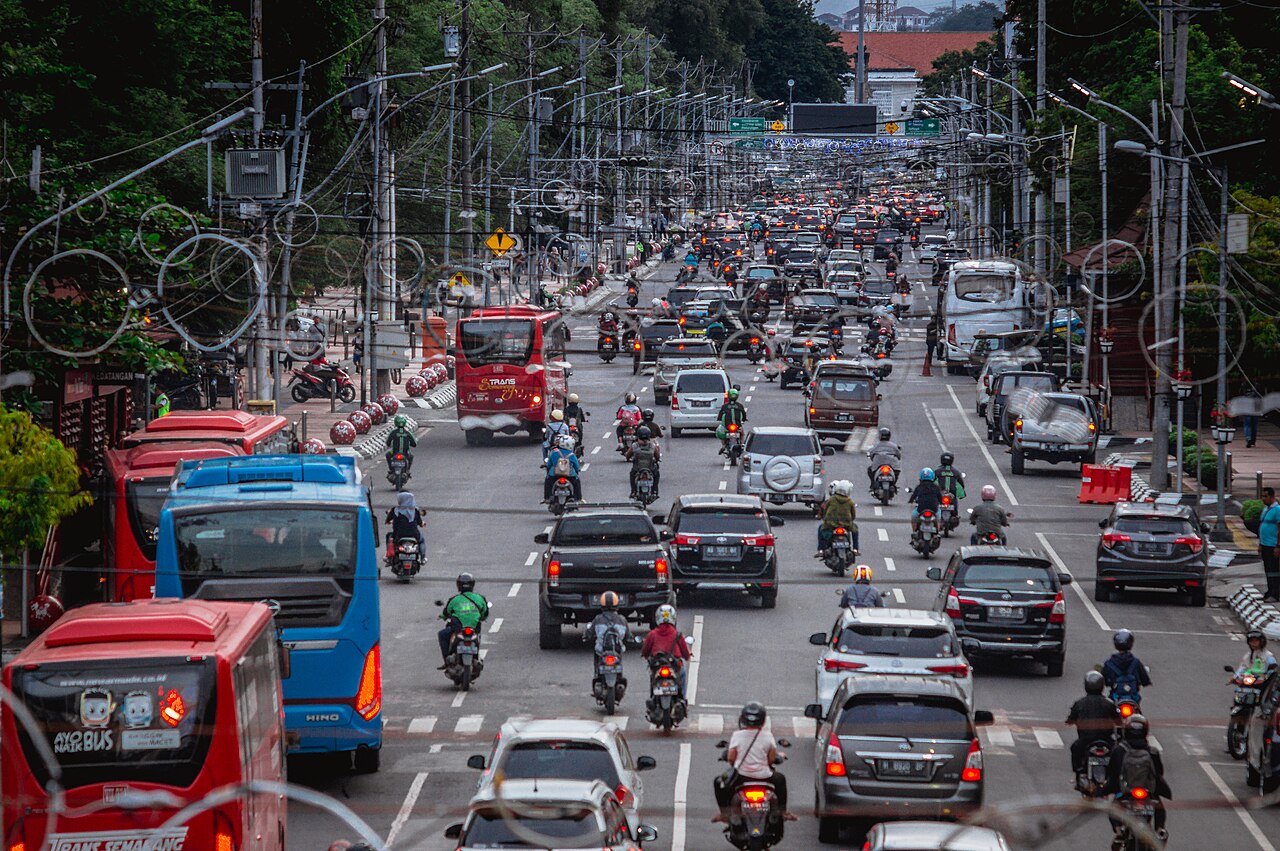
Top image: Photo: Tri Mega Widyawan, CC BY-SA 4.0, via Wikimedia Commons

Indonesia’s energy minister has talked about speeding up the conversion of as many as 120 million petrol motorbikes to electric power, CNN Indonesia reported. One route is to buy a new electric motorbike. The other is to keep the bike you already own and have a workshop swap its engine for an electric motor and battery pack. This guide explains how conversion works in Indonesia, what the rules require, what it typically costs, and where the government’s conversion grant stands in late 2026.
What conversion involves
In a conversion, a workshop removes the petrol engine and its related parts, such as the fuel tank and exhaust, and fits an electric motor (typically a brushless BLDC unit), a lithium battery pack, a controller and new wiring for the lights and instruments. Consumer guides say automatic scooters are the most common candidates, because the battery can sit in the space under the seat. A 2026 guide from Mobil123 describes typical kits with a motor of about 2–3 kW and a 60V or 72V battery, giving roughly 50–70 km per charge. Those are the publication’s estimates rather than official figures, and real range depends on battery size and riding style.
The legal rules: certified workshops and a new type test
Conversion is legal, but you cannot do it yourself and ride on public roads. The basis is Transport Ministry regulation PM 65 of 2020 on converting combustion-engine motorbikes into battery-electric ones. When the rule came in, a Transport Ministry official told detikOto that only workshops holding a ministry permit may carry out conversions, and that each converted bike must be tested again to receive a new type-test certificate (SUT).
The regulation also sets out what a conversion workshop needs. As summarised by Tirto, this includes at least one installation technician and one maintenance technician, special tools for fitting the electric drive, and equipment to test insulation resistance and protection against electric shock. In practice, this means that a cheap kit fitted by a general mechanic will leave you with a bike that does not match its registration papers.
After conversion and testing, the vehicle’s registration documents (STNK and BPKB) have to be updated at Samsat to reflect the new electric motor. Mobil123 also notes that the bike must have complete, valid papers and no unpaid vehicle tax before work starts.
How much it costs
Estimates vary, and none is an official price list:
- The energy ministry (ESDM) has put the typical cost of a conversion at around Rp15 million, according to Bisnis.com. The think tank INDEF puts it at Rp12–16 million.
- The original 2023 programme rules capped the workshop fee at Rp17 million, CNN Indonesia reported.
- Mobil123’s 2026 breakdown is higher, at Rp17.5–22.5 million before any grant. It covers the motor and controller (Rp8–10 million), the battery (Rp7–9 million), labour (Rp1.5–2 million) and testing and paperwork (Rp1–1.5 million).
Energy minister Bahlil Lahadalia has suggested that cheaper technology could bring the cost down to about Rp5–6 million per bike, CNN Indonesia reported in July. That is a target, not a price you can get today.
The government grant: lapsed for now, relaunch proposed for 2027
The ministry’s conversion programme began with pilots in 2022. Under ESDM regulation 13 of 2023, the grant rose from Rp7 million to Rp10 million per bike. Eligible bikes had petrol engines of 100–150cc, according to CNN Indonesia, while Mobil123 gives the range as 110–150cc. Take-up fell far short of the targets. The rules aimed for up to 50,000 conversions in 2023 and 150,000 in 2024. Bisnis.com reports that only hundreds were done in 2023 and about 1,500 in 2024. In February 2026, Eniya Listiani Dewi, director general of renewable energy at ESDM, put the running total at 2,250 bikes.
Under the previous scheme, the Rp10 million grant was topped up with company CSR funds so that owners paid nothing. Eniya described the arrangement to Bisnis.com:
“At the time I mobilised CSR funds to cover the Rp5 million, so it was free for the public.” (translated from Indonesian)
The regulation behind the grant ran only until 2024, and in July officials said its replacement was still in draft, with the ministry still studying whether to keep the old design. On 31 August, Bahlil told parliament’s Commission XII that the ministry was proposing Rp635.24 billion to convert 63,000 motorbikes in the 2027 budget. By our calculation, that works out to just over Rp10 million per bike. The figure was a proposal and could change during budget talks.
Some consumer articles published this year still describe a Rp10 million grant as available now. Before you commit, check the ministry’s official conversion portal or ask a certified workshop whether any quota is actually open.
Why take-up has been low
Analysts quoted by Bisnis.com point to several problems:
- Many older bikes lack complete papers, so they cannot qualify for the grant.
- Owners worry about resale value and the safety of converted bikes.
- Even after a grant, the cost is high relative to what an older scooter is worth.
- Certified workshops are few and mostly in Greater Jakarta. CNN Indonesia counted 25 registered on the programme’s website.
INDEF’s Andry Satrio Nugroho has argued for a scrap-and-replace scheme instead, in which old bikes are retired in exchange for new locally made electric ones. He has also suggested that ride-hailing and delivery fleets should come first.
Convert or buy new? What it means for buyers
For most private riders, conversion only makes sense when a grant is available. Without one, a conversion costing Rp15 million or more has to be weighed against the price of a new electric scooter, which comes with a factory warranty and dealer support. Our electric motorbike buyer’s guide covers the models and price bands. The purchase incentive for new e-motorbikes is also on hold, though, and buyers have been waiting for a decision for months.
If you do go ahead:
- Use only a workshop with Transport Ministry certification for conversions.
- Make sure the price includes the type test and the update to your STNK and BPKB.
- Ask what the battery chemistry and battery management system are, and what the warranty covers. Mobil123 suggests looking for at least three years on the battery.
- Plan your charging. A converted bike charges like any e-motorbike, and our charging guide explains home charging and battery swapping.
If the 2027 budget line survives, a new round of grants could make conversion cheap or free again for eligible owners. Until the rules are published, it is safest to treat any offer of a subsidised conversion with caution.
FAQ
Can I convert my own motorbike at home?
No, not if you want to ride it legally on the road. Under PM 65/2020, a permitted workshop must do the conversion, and the bike must pass a new type test.
Is there a conversion subsidy right now?
The grant regulation ran only until 2024. As of July, officials said the replacement rules were still in draft, and the energy ministry has proposed funding for 63,000 conversions in 2027. Check the ministry’s official portal for current quotas.
Which bikes can be converted?
Under the past grant scheme, petrol bikes in roughly the 100–150cc range qualified, and sources differ on the exact lower limit. Automatic scooters are the most common choice. The bike also needs valid registration papers.
Sources: Bisnis.com; CNN Indonesia (Feb 2026); CNN Indonesia (Jul 2026); Periskop; Mobil123; detikOto; Tirto.